Critical Interculturality and CALL in English Language Teaching: A ten-year revision of research in Colombia
Andrés Mauricio Potes-Morales1
To reference this article / Cómo citar este artículo / Para citar este artigo: Potes-Morales, A. M. (2025). Critical interculturality and CALL in English language teaching: A ten-year revision of research in Colombia. Revista UNIMAR, 43(2), 121-142. https://doi.org/10.31948/ru.v43i2.4709
Reception date: March 11, 2025
Review date: June 3, 2025
Approval date: July 30, 2025
Abstract
This article examines studies published in four Colombian journals between 2014 and 2023. A total of 91 issues were reviewed to identify articles addressing one or more of the following topics: English Language Teaching (ELT), Critical Interculturality (CI), and Computer-Assisted Language Learning (CALL). The methodology followed the three-step process proposed by Álvarez-Valencia (2014), combined with principles from the Critical Appraisal Skills Programme (CASP). The article inclusion process consisted of reviewing titles, abstracts, and keywords, followed by classification according to research type and thematic focus. Out of 791 articles, 129 were selected (99 national and 30 international) for analysis. Findings reveal a growing interest in CI, mostly expressed through reflective and theoretical articles focused on higher education. Empirical research on this topic remains limited, particularly at the school level (Grades 0 to 11) and involving teachers as participants. CALL, in turn, has been approached mainly from conventional perspectives focused on language skills development, with little to no integration of critical or decolonial perspectives. The intersection between CI and CALL remains underexplored in Colombian research, with a near absence of studies addressing both dimensions at the school level. These findings underscore the urgent need to promote empirical studies and the development of technology-mediated critical pedagogical proposals that foster transformative intercultural attitudes in these educational contexts. Consequently, this study advances actions related to the decolonization of English Language Teaching (ELT) and, as Granados-Beltrán (2018) noted, such actions are inherently connected to the research process.
Keywords: Critical Interculturality; Interculturality; Information and Communication Technologies (ICT); Computer-Assisted Language Learning (CALL); English Language Teaching (ELT); English as a Foreign Language (EFL); literature review
Interculturalidad crítica y CALL en la enseñanza del inglés: revisión de una década de investigación en Colombia
Resumen
Este artículo examina los estudios publicados en cuatro revistas colombianas entre 2014 y 2023. Se revisaron 91 ediciones para identificar artículos que abordaran uno o varios de los siguientes temas: enseñanza del inglés (ELT), interculturalidad crítica (CI) y aprendizaje de idiomas asistido por computador (CALL). La metodología siguió el proceso de tres pasos propuesto por Álvarez-Valencia (2014) y principios del Critical Appraisal Skills Programme (CASP). El proceso de inclusión de artículos consistió en la revisión de títulos, resúmenes, palabras clave, y posteriormente la clasificación por tipo de investigación y enfoque temático. De un total de 791 artículos, se seleccionaron 129 (99 nacionales y 30 internacionales) para su análisis. Los hallazgos revelan un creciente interés en la CI, expresado mayoritariamente en artículos reflexivos y revisiones teóricas centradas en la educación superior. La investigación empírica sobre esta temática sigue siendo limitada, especialmente en los niveles escolares y con participación docente. CALL, por su parte, ha sido abordado principalmente desde enfoques convencionales centrados en el desarrollo de habilidades lingüísticas, sin integrar perspectivas críticas o decoloniales. La intersección entre CI y CALL permanece como un campo incipiente en la investigación colombiana, con una ausencia casi total de estudios que aborden ambas dimensiones a nivel escolar. Estos hallazgos evidencian no solo la necesidad de impulsar estudios empíricos en estos niveles, sino también de construir propuestas pedagógicas críticas mediadas por tecnología que promuevan actitudes interculturales transformadoras. En consecuencia, el presente estudio contribuye a la generación de acciones vinculadas a la descolonización del ELT, ya que como lo señala Granados-Beltrán (2018), estas acciones están conectadas con el ejercicio mismo de investigación.
Palabras clave: interculturalidad crítica; interculturalidad; tecnologías de la información y la comunicación (TIC); Computer-Assisted Language Learning (CALL); English Language Teaching (ELT); English as a Foreign Language (EFL); revisión de la literatura
Interculturalidade crítica e CALL no ensino de inglês: Revisão de uma década de pesquisa na Colômbia
Resumo
Este artigo examina os estudos publicados em quatro periódicos colombianos entre 2014 e 2023. Foram revisadas 91 edições para identificar artigos que abordassem um ou mais dos seguintes temas: ensino de inglês (ELT), interculturalidade crítica (CI) e aprendizagem de línguas assistida por computador (CALL). A metodologia seguiu o processo de três etapas proposto por Álvarez-Valencia (2014), complementado com princípios do Critical Appraisal Skills Programme (CASP). O processo de inclusão de artigos consistiu na revisão de títulos, resumos e palavras-chave, seguido da classificação por tipo de pesquisa e foco temático. De um total de 791 artigos, foram selecionados 129 (99 nacionais e 30 internacionais) para análise. Os resultados revelam um crescente interesse pela CI, expresso principalmente por meio de artigos reflexivos e teóricos centrados no ensino superior. A pesquisa empírica sobre essa temática ainda é limitada, especialmente nos níveis escolares e com a participação de professores. CALL, por sua vez, tem sido abordado principalmente a partir de perspectivas convencionais voltadas para o desenvolvimento de habilidades linguísticas, sem incorporar enfoques críticos ou decoloniais. A interseção entre CI e CALL permanece como um campo incipiente na pesquisa colombiana, com ausência quase total de estudos que abordem ambas as dimensões no nível escolar. Esses achados evidenciam não apenas a necessidade de promover estudos empíricos nesses níveis, mas também de construir propostas pedagógicas críticas mediadas por tecnologia que promovam atitudes interculturais transformadoras. Em consequência, este estudo contribui para a geração de ações vinculadas à descolonização do ELT, pois, como afirma Granados-Beltrán (2018), essas ações estão conectadas ao próprio exercício da pesquisa.
Palavras-chave: Interculturalidade crítica; interculturalidade; tecnologias da informação e comunicação (TIC); CALL; ensino de inglês; EFL na Colômbia; revisão de literatura
From crisis to opportunity: Integrating CALL and Critical Interculturality in ELT
The integration of technology in education has been a growing focus over recent decades, with the COVID-19 pandemic amplifying its importance. Information and communication technology (ICT) became crucial during this period, facilitating remote work and learning processes in schools and universities worldwide. Jin et al. (2022) suggest that the pandemic may have forever altered the landscape of language education, with educators now more open to adopting online teaching despite initial challenges in training and support (Hodges et al., 2020).
In this unprecedented context, emergency remote language teaching and learning (ERLTL) and Computer-Assisted Language Learning (CALL) gained prominence within English Language Teaching (ELT) (Jin et al., 2022). CALL has often been implemented through communicative approaches and the development of Intercultural Communicative Competence (ICC), as outlined in Colombian educational documents such as the ‘Estándares Básicos de Competencias en Lenguas Extranjeras: Inglés’ (Ministerio de Educación Nacional [MEN], 2006) and the ‘Lineamientos curriculares. Idiomas extranjeros’ (MEN, n.d.). Byram (1997) defines ICC as the ability to interpret and understand cultural information by decentered consideration of others’ perspectives, including their differing opinions, values, and communication behaviors.
Various approaches to teaching languages through ICC using technology have emerged globally. Studies have examined cultural aspects such as celebrations, music, and traditions to help students develop a more global perspective by contrasting cultural differences (Liaw, 2006; Peng, 2018; So-Yeon, 2015); Uzun, 2014). Others have focused on improving language skills to facilitate effective communication (Cadena-Aguilar et al. 2019; Gálvez & Del Campo, ٢٠٢٣; Guzmán & Moreno, 2019). Critical Interculturality (CI) has recently emerged as a critical intercultural perspective. CI emphasizes deeper social, political, and economic issues; local needs; and the development of students’ agency to engage in societal dynamics (Granados-Beltrán, 2016; Restrepo & Rojas, 2010; Usma et al., 2018; Walsh, 2010).
Despite advancements in CI and CALL, research connecting these two areas remains scarce, particularly at the primary and secondary school levels2 in Colombia. Emergency measures implemented during the COVID-19 pandemic underscored the importance of integrating technology into education for crisis preparedness and its broader educational benefits (Jin et al., 2022). Considering Colombia’s social context, which is characterized by inequality and a history of violence (Helg, 1987), it is crucial to explore how the intersection of CALL and CI can help students critically engage with social issues.
Although some studies in Colombia have addressed CI through CALL, these studies have primarily focused on higher education and have not thoroughly examined critical cultural factors. For example, Jánica et al. (2006) recommended using internet-based materials to provide access to a variety of cultural resource content. In contrast, Álvarez-Valencia and Fernández-Benavides (2019) examined the use of social networking sites for language learning (SNSLL) to develop intercultural competence (ICC) without engaging in critical cultural discussions.
Public schools often have fewer educational resources than private schools, which affects access to technology and curricular development (Pontificia Universidad Javeriana & Laboratorio de Economía de la Educación [LEE], 2022). Nevertheless, this does not preclude the effective use of available technology. At the school level, the main focus of CALL studies has been on developing communicative competence (CC) rather than explicitly addressing ICC or cultural intelligence (CI). As will be seen in the sections below, research has prioritized technological tools over students’ learning needs, aiming to improve English proficiency in areas such as speaking, listening, grammar, vocabulary, and reading. Although some studies have included intercultural encounters, they were not the explicit focus of the research.
In line with this scenario, this article reviews studies published in four Colombian journals from 2014 to 2023 that examine the intersection of content-based instruction (CBI) and computer-assisted language learning (CALL) in English language teaching (ELT). Of the 791 articles published in a decade, this review analyzed 129 articles (99 national and 30 international), highlighting the growing interest in CI and the need for more empirical research connecting CI and CALL, especially at the school level. As Granados-Beltrán (2018) noted, decolonizing ELT requires a substantial body of research conducted by educators. This review aims to support this goal.
Embracing Critical Interculturality: Transforming ELT in Latin America
Recognition of ethnic and cultural values in Latin America began in the 1980s and 1990s, when policies started incorporating the term ‘interculturality’ to foster positive relations between different cultural groups (Walsh, 2010). However, Walsh notes that the concept of interculturality remains ill-defined due to its broad application and frequent use as a buzzword in policy documents. To address this issue, she proposes categorizing interculturality into three broad types.
The first type, relational interculturality, involves interactions between cultures and their respective values, traditions, and customs. However, these interactions often occur under unequal conditions, which perpetuate power imbalances, domination, and colonialism. This approach limits interculturality to mere contact and interaction, overlooking crucial societal structures such as politics, economics, and epistemology. Therefore, Walsh (2010) argues for moving beyond the relational perspective to consider the social and political implications of interculturality.
The second type, functional interculturality, aims to promote tolerance, recognition, dialogue, diversity, and cultural difference (Tubino, 2005). However, despite its intentions, this perspective is often driven by neoliberal agendas and fails to address the underlying causes of social and cultural divides. Effective cultural dialogue must incorporate critical factors missing from the relational perspective: Social, economic, political, and epistemological dimensions (Walsh, 2010).
The third type, Critical Interculturality (CI), differs significantly from the previous two categories in that it addresses structural, colonial, and racial issues impacting society, the economy, politics, and academia (Walsh, 2010). CI is a tool, process, and project developed by marginalized individuals within the social hierarchy. This contrasts with the top-down nature of functional interculturality. CI aims to transform social and institutional structures by creating new ways of being, thinking, knowing, learning, and living. CI moves beyond merely recognizing and incorporating ‘difference’ into existing structures. It demands political agency and action to foster genuine transformation. This aligns with Freire´s, (1987) notion that genuine transformation stems from individuals developing a consciousness through communal engagement. This consciousness leads to political action that supports the emancipation of oppressed and marginalized individuals. Freire posits that education should be inherently political to effect societal transformation, a principle that is central to CI. In the Latin American context, Perales (2013) found that engaging students in close analysis of ideologically charged texts fosters awareness of multiple positions within a cultural context. This process also prompts reflection on culturally rooted assumptions that shape interpretations. This approach aligns with the transformative aims of critical interculturality in ELT. ELT from an intercultural perspective, in this context, is rooted in critical pedagogies and reflects a significant evolution in the Global South, including Colombia (Granados-Beltrán, 2016; Restrepo & Rojas, 2010; Tubino, 2005; Usma et al., 2018; Walsh, 2010).
Integrating technology in language learning: The role of CALL
Computer-Assisted Language Learning (CALL) is a significant field within language education, distinguished by the unique requirements for teaching languages with computer technology (Levy & Hubbard, 2005). CALL is a subset of applied linguistics that focuses on using computer technology to facilitate language teaching and learning. It is important to understand what is meant by ‘computer technology’. According to Techopedia (2024), computers are machines that perform processes, calculations, and operations based on instructions from software or hardware programs. This definition includes a range of smart devices, including smartphones, tablets, laptops, and smart TVs (Beatty, 2010; Chapelle & Jamieson, 2008; Techopedia, 2024). Consequently, CALL is language teaching through any computer-like device.
Levy and Hubbard (2005) emphasize that the term CALL is widely accepted in language education for two main reasons. First, language learning is different from other subjects and requires a specialized approach when taught through technology. Second, CALL has long been validated within the global academic community. It has formed the foundation of numerous journals and research organizations, including the CALL Journal, the ReCALL Journal, the CALICO Journal, the JALTCALL Journal (Japan Association of Language Teachers CALL Interest Group), the APACALL Journal (Asia Pacific Association for CALL), and the PacCALL Journal (Pacific CALL Association), among others.
In contemporary settings, various terms are used to describe the technologies and devices employed in language education. These include Technology Enhanced Language Learning (TELL) (Casanovas, 2002), Computer Mediated Communication (CMC), Integrated Learning Systems (ILS) (Blyth, 2008), Mobile English Language Learning (MELL) (Elaish et al., 2019), Social Networking Sites for Language Learning (SNSLL) (Álvarez-Valencia & Fernández-Benavides, 2019), Network-Based Language Teaching (NBLT), and Emergency Remote Learning (ERL), among others. Each of these approaches represents a different facet of how technology can be utilized to enhance the language learning experience.
In this scenario, the methodology for this study is based on the three-step process proposed by Álvarez-Valencia (2014), which incorporates principles from the Critical Appraisal Skills Programme (CASP) to ensure a structured and rigorous evaluation. This process certified a comprehensive examination of trends, gaps, and research needs in the intersection of ELT, CI, and CALL in Colombia. The details of the methodology are explained in the following section of this article.
Revision Methodology
The objective of this review is to analyze articles addressing one or more issues related to ELT, CI, and CALL in Colombia. To gain a clearer understanding of the current Colombian scholarship on this matter, we reviewed both empirical and theoretical articles, including empirical research reports, theory-based articles, and reflective pieces. The sources for the review included four well-known ELT journals from prominent Colombian institutions. Profile, from the Universidad Nacional de Colombia, shares the results of classroom research projects, reflections, and innovations undertaken by English as a second or foreign language teachers, teacher educators, and novice teacher-researchers (Profile, 2024). Íkala, from Universidad de Antioquia, publishes empirical studies, literature reviews, theoretical and methodological articles, case studies, and book reviews written in English, Spanish, French, or Portuguese (Íkala, 2024). Colombian Applied Linguistics (CALJ), from Universidad Distrital Francisco José de Caldas, covers research and teaching issues in the field of Applied Linguistics for the Teaching of English (CALJ. 2024), and HOW, from the Asociación Colombiana de Profesores de Inglés (ASOCOPI), covers experiences related to teaching and learning English as a second, foreign, additional, or international language (ESL, EFL, EAL, EIL) (HOW, 2024). It is noteworthy that these Colombian journals accept and publish both national and international articles. Of the articles included in this review, 99 were conducted in Colombia and 30 were conducted internationally. The findings from the 99 national papers are presented in the following pages. A brief analysis of the data from the 30 international papers is provided in the discussion section of this review to offer a means of contrasting national trends. At the time of publication of this article, three of these journals were indexed according to the Colombian indexing system, except for HOW. As advocates for decolonial theory, critical pedagogies, and critical incident (CI) theory, we emphasize that the absence of indexation should not diminish the value of research published in non-indexed journals, particularly those by pre-service and novice teachers.
Selection of articles
To find eligible articles, we followed the three-step process proposed by Álvarez-Valencia (2014), which aligns with the Critical Appraisal Skills Programme (CASP), as explained in the following paragraphs. First, we examined the table of contents of the 91 issues of the selected journals to identify headings that addressed one or more of the three issues: ELT, CI, and CALL. Next, the abstracts and keywords of the preselected articles were reviewed to determine if they primarily focused on the issue of ELT, and one of the other two issues. A total of 129 articles were selected: 99 from national sources and 30 from international sources, as shown in Table 1. Among the selected papers by national origin, there are 25 articles from Profile, 20 from Íkala, 21 from CALJ, and 33 from HOW. Third, the data were carefully read and sorted by article types, including empirical and theoretical or reflective research. Within these categories, the issues addressed were also classified: CALL, critical pedagogies, decoloniality, and critical interculturality.
Table 1
General characterization of the articles reviewed
|
Journal |
Years of publication examined |
Number of issues in the 10 years |
Number of articles published |
National |
International |
Number of articles reviewed |
|
Profile |
2014 - 2023 |
21 |
256 |
25 |
8 |
33 |
|
Íkala |
30 |
194 |
20 |
9 |
29 |
|
|
CALJ |
20 |
182 |
21 |
8 |
29 |
|
|
HOW |
21 |
159 |
33 |
5 |
38 |
It is important to note that, while this methodology is based on the three-step process proposed by Álvarez-Valencia (2014), it was also intentionally designed to align with several criteria from the CASP. One of these criteria is the need to address a focused issue (CASP, 2024; Williams et al., 2020). This review meets that requirement by specifically focusing on the intersection of ELT, CI, and CALL in Colombian research over the past decade. By clearly defining this scope, the study ensures that the selection process remains aligned with its overarching research objective.
Secondly, the appropriateness of the methodology, another key CASP criterion, is reflected in the structured yet adaptable approach used in this review (CASP, 2024; Williams et al., 2020). The three-step process—reviewing journal contents, analyzing abstracts and keywords, and categorizing full-text articles—allows for a targeted examination of ELT scholarship. While this method does not apply rigid inclusion/exclusion criteria as seen in systematic reviews, it enables a focused identification of trends and research gaps in CI and CALL within ELT.
A third alignment with CASP relates to the appropriateness of study selection. In place of participant selection (as seen in empirical research) (CASP, 2024; Williams et al., 2020), this review ensures article selection is guided by thematic relevance within four widely recognized Colombian ELT journals. The categorization of studies into empirical versus theoretical or reflection-based, along with further classification by research focus (CALL, CI, conventional ELT approaches), offers a structured way to analyze the main research orientations within the field.
Lastly, CASP emphasizes clear presentation of findings, a criterion that is well-aligned with this study’s organization of results (CASP, 2024; Williams et al., 2020). By structuring the analysis into distributions of research types, participant categories, and thematic concentrations, this review not only highlights prevailing trends but also identifies underexplored areas—such as the lack of empirical studies on CI at the school level or the scarcity of CALL research that engages with critical perspectives. These findings are presented in a way that allows educators, researchers, and policymakers to visualize key patterns and gaps within Colombian ELT research.
Findings
Important data was found related to theoretical or reflection papers and empirical research on ELT, CI, and CALL. The articles reviewed in this ten-year analysis highlight the current state of Colombian scholarly research, supporting researchers in their work on one or more of these topics.
Types of articles
A total of 129 articles were reviewed: 99 from Colombia and 30 from other international sources. This section is focused on the Colombian papers. The findings drawn from the international papers published in the four national journals will be addressed in the discussion section, providing a means of contrast with national trends. Across the 99 national papers, a broad categorization was made according to the type of data provided by each article, being theoretical or reflective papers, and empirical papers, the main categories. Among these two main categories, the papers were classified according to the issues they addressed concerning the interest of this review, namely ELT, CALL, and CI.
Of the 99 papers reviewed, 22 (22.2%) were categorized as theoretical or reflective, while 77 (77.7%) were categorized as empirical. All 99 papers addressed ELT issues, such as methodologies, teaching experiences, types of interculturality, language skill development, and language policy.
First category: Empirical research
Regarding specific issues analyzed, among the 77 papers classified in the empirical research category, 25 papers addressed CALL tools or methodology implementation (32.46%), 22 papers had approaches founded on decoloniality, critical pedagogies, or CI, 17 at the higher education level (22%), and five at the school level (6.4%). Nine papers indirectly addressed decoloniality, critical pedagogies, or CI at all levels (11.6%). Surprisingly, 59 papers focused on conventional approaches to ELT (76.6%), such as the development of linguistic skills (40%), linguistic structures, functions, or contents (6.4%), and communicative competence (29.8%). Figure 1 accounts for these preliminary findings:
Figure 1
Account of empirical articles published in the four national journals reviewed over ten years concerning specific issues of ELT
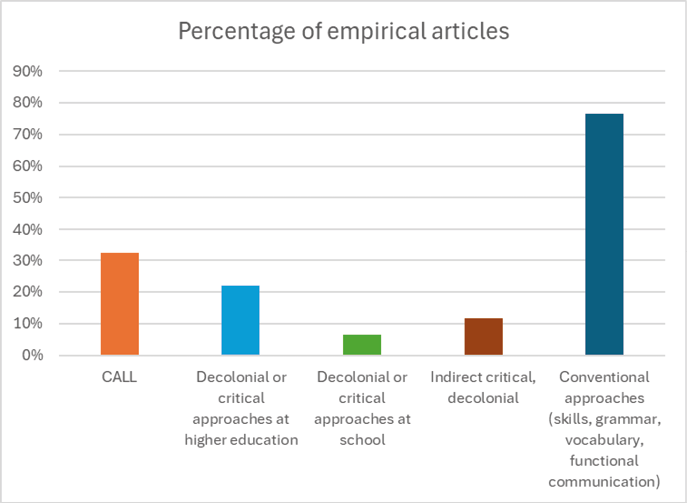
As shown in Figure 1, few studies have been conducted at the school level that implement or aim to develop a decolonial or critical approach to ELT. By contrast, most articles continue to focus on developing one or more language skills and/or cover grammar, vocabulary, and functional aspects of language communication. These articles focus on superficial aspects of the target language culture, such as celebrations, gastronomy, famous sites, and traditions. As pointed out by Henao et al. (2019), although these types of inquiry aim to develop general language skills, they do not give students opportunities to go beyond factual knowledge or develop cultural understanding and sensitivity. Núñez-Pardo (2020) contends that publishing houses in Colombia are colonized in terms of knowledge, power, and identity, which is reflected in the contents and activities proposed in the textbooks used in ELT. Additionally, Usma et al. (2018) recommend a reform at all educational levels that recognizes indigenous and local knowledge, culture, and traditional languages.
Second category: Theoretical or reflective research
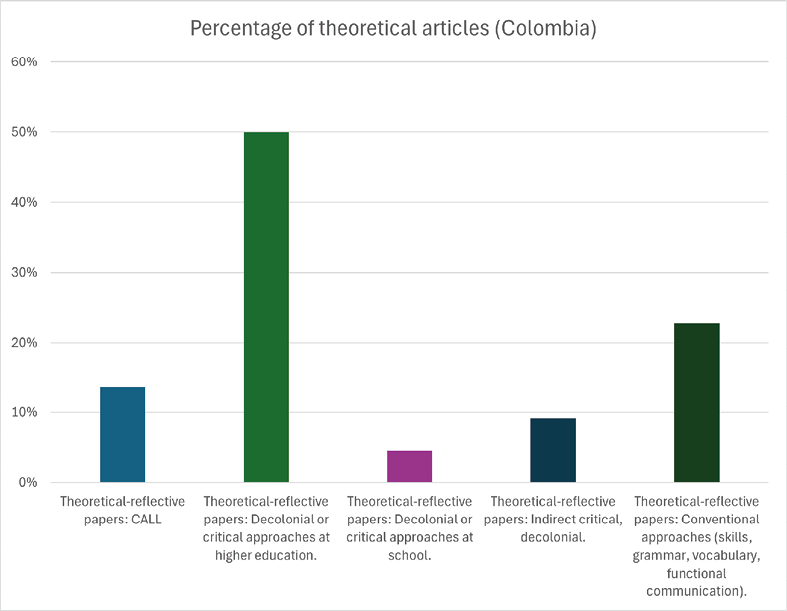
22 articles were classified into the category of theoretical or reflective research regarding specific issues. From the 22 articles, three papers addressed CALL tools or methodology implementation (13.6%), eleven papers addressed decoloniality, critical pedagogies, or CI at the higher education level (50%), one paper addressed decoloniality, critical pedagogies, or CI at the school level (4.5%), two papers indirectly addressed decoloniality, critical pedagogies, or CI, one at the higher education level, and one as a reflection on textbooks for the school level (9.1%), five papers focused on conventional approaches to ELT (22.7%) such as the development of linguistic skills (9.1%), linguistic structures, functions or contents (4.5%), and communicative competence (9.1%).
Figure 2
Account of theoretical or reflective articles found in the four national journals reviewed in ten years regarding specific issues of ELT
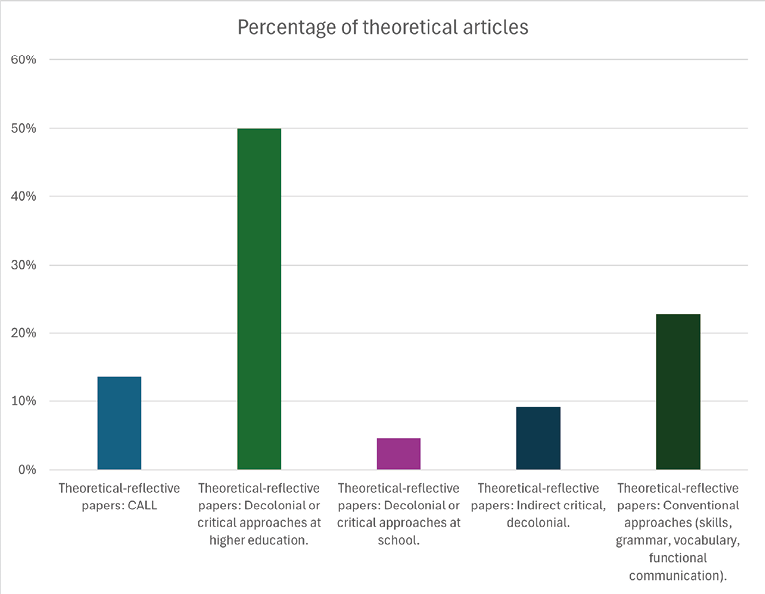
As shown in Figure 2, in the category of theoretical or reflective papers, the topics of decoloniality, critical pedagogies, or CI had the highest percentage (50%) at the higher education level, compared to other issues. This reflects a growing interest in these topics within the academic community across different areas of universities.
In the second half of this category, the highest number of articles is concerned with conventional approaches to ELT with 22.7% (linguistic skills, linguistic structures, and communicative competence), followed by a 13.6% of papers addressing CALL, 9.1% of papers which indirectly address critical pedagogies, decoloniality or critical interculturality, and with the lowest recurrence, 4.5% of papers addressed CI.
Before analyzing these final results, it is important to clarify what is meant by ‘indirectly addressing critical pedagogies, decoloniality, or CI’. Papers categorized under this issue do not directly contribute to decoloniality, critical pedagogies, or CI literature; however, some of their findings, discussions, or conclusions indirectly support the theoretical inquiry in these areas.
Figure 2 highlights the limited amount of theoretical research on decoloniality, critical pedagogies, and CI. More notably, the fewest studies are found at the school level, with just one article (4.5%). And even more noteworthy is the fact that the author of this single article is a foreign scholar who reviewed Colombian empirical studies and wrote a reflection paper contrasting private schooling with public schooling from the lens of coloniality, monoglossic, and hegemonic language ideologies, and policies. The author highlights that, first, bilingual education in Colombia upholds hegemonic language ideologies that marginalize local linguistic identities. Second, the hierarchy that favors English is prevalent in both public and private sectors, perpetuating colonial values. Third, she argues that despite some teachers moving away from these oppressive practices, there is an urgent need for more large-scale empirical research in classrooms across the entire country. (Bettney, 2022).
Participants
Regarding participants across the 77 empirical papers reviewed for this 10-year revision, 25 papers had higher education students (32.5%), 21 papers had higher education teachers and pre-service teachers at universities or institutes (27.3%), 24 papers had students at school level (31.2%), and 7 papers had teachers at school level (9.1%).
Figure 3
Percentage of empirical articles categorized by the type of participants
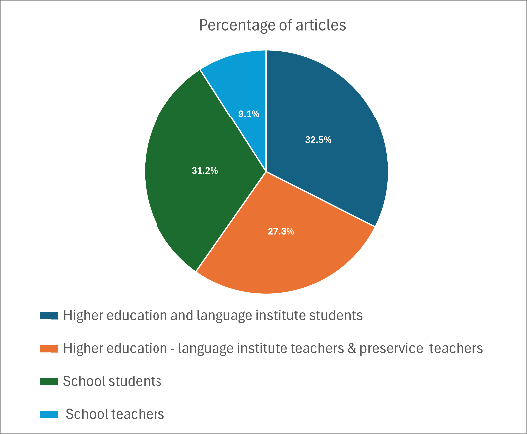
As illustrated, 25 empirical studies recruited students from the higher education level, followed by students from the school level, with 24 papers. These two scenarios alone account for 63.6% of the empirical studies. Regarding the studies involving teachers and preservice teachers, 21 of them took place at the higher education level 27.3%, while only seven were conducted at the school level (9.1%), accounting for 36.4%. This set of data evidences a clear need for more empirical research where participants are teachers, especially at the school level, where the occurrence is the lowest (9.1%).
Empirical research participants on: CALL
Regarding the distribution of participants according to the specific issues analyzed, it was found that, from the 25 empirical papers that addressed CALL, twelve had higher education and language-institute students as participants (42.9%), five had higher education and language institute teachers (17.9%), eight had school students (28.6%); no were jobs that had elementary level teachers (0%).
Figure 4
Percentage of empirical articles on CALL categorized by the type of participants
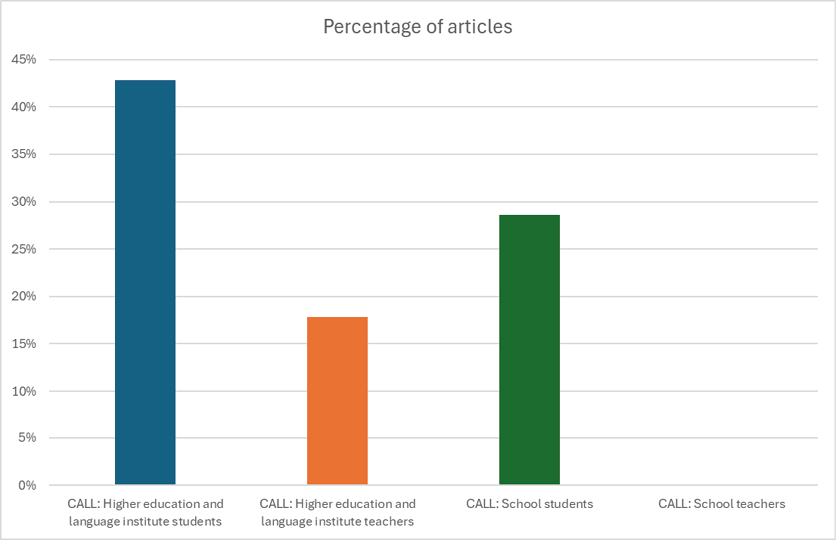
As Figure 4 shows, most participants in the empirical literature on CALL are higher education students, accounting for 42.9%, followed by school-level students at 28.6%. Both sets of data account for 71.4% of participants who are students. In comparison, only 17.9% of participants are teachers from the higher education level, and a notable 0% are teachers from the school level. These data indicate a need for more empirical research, which involves teachers from the school level as participants in matters of CALL in ELT, as shown.
Empirical research participants on: Critical Pedagogies, Decoloniality, and Critical Interculturality
In the second distribution of participants according to the specific issues analyzed, it was found that, from the 22 empirical studies concerning the issue of decoloniality, critical pedagogies, and CI, eight articles had higher education and language-institute students as participants (36.36%). Nine had higher education and language-institute teachers as participants (40.9%). The higher education level alone accounts for 77.26% of the participants in the empirical research conducted regarding the issue of Critical Pedagogies, Decoloniality, and CI. In contrast, at the school level, it was found that the number of papers was significantly lower, with four papers where participants were students (18.1%), and only one where participants were teachers (4.5%) (See Figure 5).
Figure 5
Percentage of empirical articles on decoloniality, critical pedagogies, and CI categorized by the type of participants
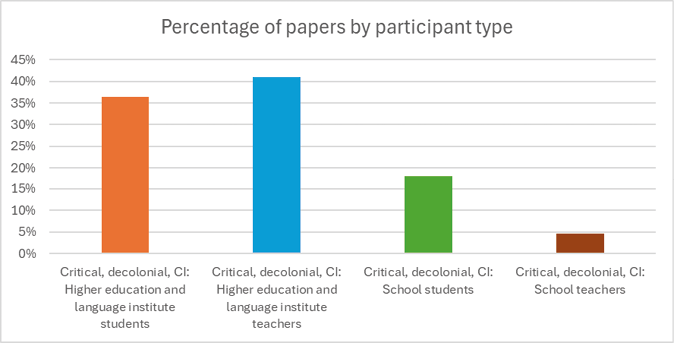
As Figure 5 shows, most empirical research on decoloniality, critical pedagogies, and CI occurs at the higher education level, with roughly equal numbers of students and teachers participating. However, there is limited research on empirical studies in schools, particularly those that recruit school teachers as participants.
Discussion
National research advancement
The review of Colombian scholarly research on ELT, CI, and CALL over the past decade reveals significant insights and notable gaps. One of the most striking findings is the predominance of empirical research, with 77.7% of the reviewed articles falling into this category. However, taking a closer look at these empirical studies reveals a clear imbalance in the focus areas and levels of education addressed.
A significant portion of the empirical research (76.6%) continues to concentrate on conventional approaches to ELT, such as linguistic skills development and communicative competence, reflecting a traditional view of language teaching and learning. By contrast, only 6.4% of empirical studies conducted in schools address decolonial approaches, critical pedagogies, or critical inquiry (CI), which highlights a significant gap in research.
Similar trends are also evident in theoretical or reflective articles. Although there is a growing interest in critical pedagogies and CI at the higher education level (50% of the theoretical papers), this interest sharply declines at the school level, with only one article addressing CI. This scarcity is concerning, given the importance of developing critical intercultural attitudes from an early age.
Furthermore, the distribution of participants in these studies highlights the existing research gaps. The majority of the empirical studies involve higher education students (32.5%) and teachers (27.3%), while only 31.2% involve school students, and a mere 9.1% involve school teachers. This skewed distribution suggests a need for more research that includes school-level participants, especially teachers, to better understand and integrate CI and CALL at this crucial educational stage.
In terms of CALL, the focus remains predominantly on higher education, with 42.9% of the studies done by students and 17.9% done by teachers. Only 28.6% of the CALL studies include school students, and none involve school teachers. This indicates a significant gap in the implementation and study of CALL methodologies and tools at the school level, which could play an important role in integrating CI into the language learning process through technology.
International trends
As pointed out in the first section of this article, 30 international articles were selected from the four Colombian journals reviewed, namely Profile, Íkala, CALJ, and HOW. In addition to meeting the selection criteria, which requires addressing the issue of ELT and one of the other two issues of interest (CI and CALL), they provide a reference for evaluating ELT research in Colombia compared to neighboring countries. Among the countries that were represented in these papers are the United States, Chile, Spain, Mexico, Argentina, Iran, Saudi Arabia, Brazil, New Zealand, Indonesia, and Canada. Surprisingly, the findings were similar to the ones obtained at the national level regarding the research gap in the intersection of CI and CALL in ELT (See Figure 6).
Figure 6
International empirical studies
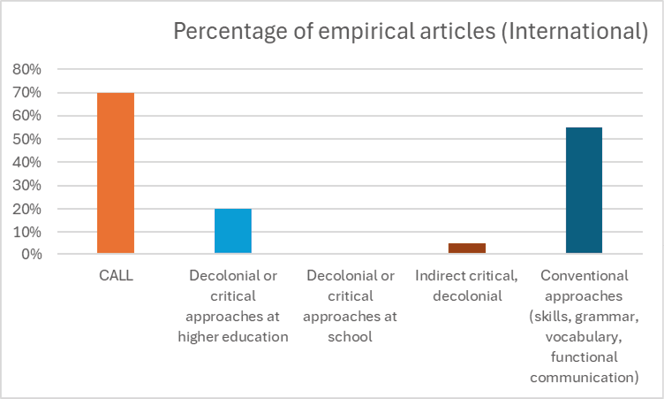
Figure 7
National studies
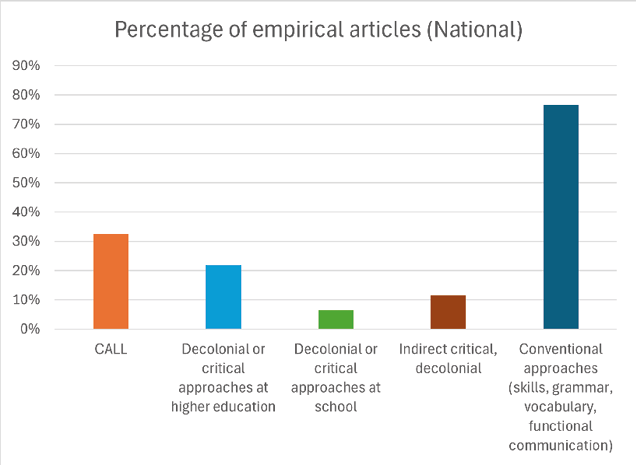
Figure 6 shows that there are some similar trends in research interest regarding the issues of ELT explored in this review, as evidenced by international-level empirical studies. The data show a higher interest rate in matters of CALL with 14 articles, and eleven articles in conventional approaches to ELT. These two issues intersected in more than half of the empirical cases, in ten studies. Together, these two issues account for 75% of the total number of empirical papers selected internationally. In contrast, only 20% of the international studies addressed the issue of CI at the higher education level, and 0% at the school level. This finding is relevant since data reflect an interest in international scholarship for publishing ELT research in Colombia. There is a clear lack of research on critical pedagogies, decoloniality, and CI at the school level. Only 5% of the papers found were empirical, and none were found at the international level. This gap is significant, and Colombian scholars should investigate it.
Regarding the theoretical and reflective articles in the national context (Figure 7), it was found that articles in Colombia are more advanced in critical pedagogies, decoloniality, or CI development in ELT scholarship. When comparing the articles that explore these issues in the ten years reviewed, Colombian academics have produced more theoretical reflections on these issues than scholars who published in the four journals reviewed during the same period. The international theoretical papers have shown higher interest in conventional approaches regarding language skills, grammar, vocabulary, and functional communication (See Figure 7).
Figure 8
Theoretical articles (international)
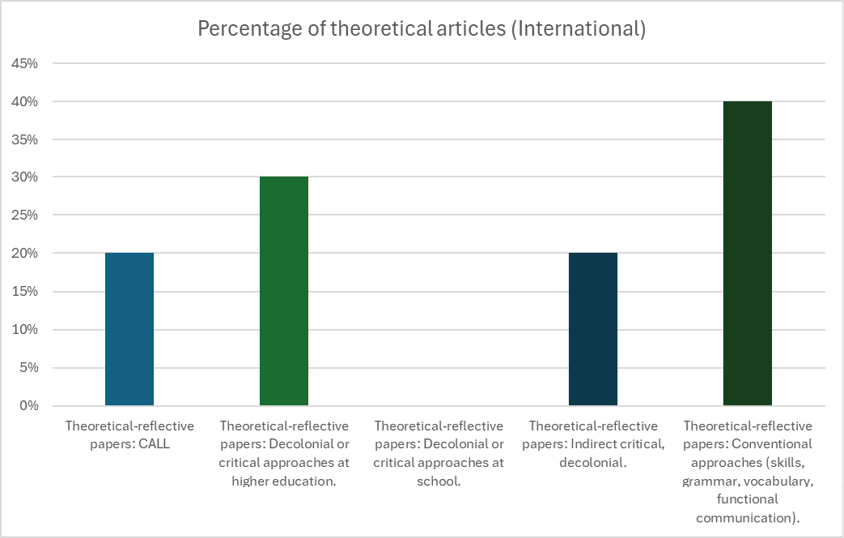
Figure 9
Theoretical articles (national)
As shown in Figures 8 and 9, the vast majority of articles that discuss critical pedagogies, decoloniality, or CI both at the international and national levels target the higher education level, leaving the school level as a scarcely explored milieu.
These findings suggest reflection on the structural reasons behind the scarcity of research on CI and CALL in school contexts. One possible explanation is the gap between the critical training developed in universities and the practices that are implemented in school settings—often constrained by limited infrastructure, rigid curricula, or public policies focused on linguistic standards. The predominance of textbooks and standardized tests that reinforce functional views of English exacerbates this situation, limiting the development of more critical and intercultural approaches. The absence of studies addressing the use of technology from a critical perspective—particularly at the school level—signals the need to build a research agenda that not only explores the pedagogical potential of digital tools, but also questions power relations, colonial discourses, and epistemic exclusions embedded in English language teaching in Colombia. Including empirical research from Latin America that already engages with these critical approaches to EFL could help expand regional dialogue and strengthen the relevance of future proposals.
Noteworthy reflections from Colombian scholarship
Over the past decade, numerous articles have contributed significant reflections and recommendations on the intersection of critical interculturality and CALL in ELT. These insights offer a thorough understanding of how educators and researchers navigate the complexities of incorporating critical perspectives into language education. The following section synthesizes key themes and recommendations from various studies, highlighting the commonalities and unique contributions of each. In this section, we will first share reflections that underscore the importance of community engagement, local contextualization, empowerment, social justice, decoloniality, and critical literacies in shaping effective and transformative ELT practices.
Lastra et al. (2018) and Nieto (2018) highlight the significance of connecting with local contexts as a source of inspiration for professional development and critical literacy. They argue that pre-service teachers who engage with local issues are better equipped to problematize social matters, integrating these into their planning processes and fostering personal inquiries among students. This local engagement enriches their stances on education and language learning. Lastra et al. (2018) emphasize the importance of Community-Based Pedagogy in shaping pre-service teachers’ identities as social agents. They conclude that they cannot remain outsiders. Instead, they need to integrate themselves into the educational community to improve understanding and connect it to the classroom.
Through the same lens, Bolaños et al. (2018)define empowerment as the confidence and freedom students gain through the learning process, enabling them to interact more effectively in the classroom. This empowerment boosts their self-confidence, decision-making skills, and ability to express their viewpoints. It motivates them to perform better in the classroom. Additionally, they advocate for viewing rural education as an opportunity to promote equity in Colombia, particularly within the context of the country’s pursuit of peace. An approach that empowers teaching and learning participants leads pre-service teachers to realize that their role extends beyond the classroom walls and the content they deliver. Teachers and learners collaboratively construct knowledge, exercising agency to the extent that students become cognitively engaged and challenged (Bolaños et al., 2018; Lastra et al., 2018; Nieto, 2018).
Contreras and Chapetón (2016) advocate viewing language as a social practice in which teachers encourage social awareness and critical thinking. By incorporating EFL syllabus content with students’ realities, educators can help students understand and reflect on their social contexts. This will allow them to gradually become active agents of social transformation. Valuing students’ familiar and social contexts, as well as including relevant topics, makes the learning process more meaningful and engaging for students.
On another front, Granados-Beltrán (2016) questions the current focus on skill acquisition for its own sake, advocating instead for language pedagogy to have an ethical goal of constructing intersubjective meanings. This approach helps individuals understand themselves and others, contributing to the creation of better societies. The author also emphasizes the need to question the necessity of English proficiency when foundational literacy and citizenship skills are lacking and highlights the power struggles inherent in cultural pedagogy and knowledge geopolitics. In the article, the author calls for an epistemic break in ELT, challenging academic colonialism in Colombia. In another article, Granados-Beltrán (2022) asserts that teachers develop various ways of knowing to build local knowledge in their ELT discipline. For the author, it is crucial that prospective teachers get familiar with local teaching models, knowledge, and practices of rural, indigenous, and Afro-descendant environments. As a result, they could question the standard way of teaching languages and build the ‘diversality’ or ‘pluriversality’ suggested within CI.
In this vein, the author argues for questioning, displacing, and subverting colonial concepts and practices to construct and liberate through decolonial pedagogy. This involves a critical understanding of history, redeployment of emancipatory educational practices, and de-centering from colonial epistemes. The goal is to move from being consumers of foreign educational materials to becoming producers of knowledge, culture, and justice.
As such, Hurie (2018) critiques the neoliberal framework of English language teaching in Colombia, particularly within the ‘English for peace’ discourse. Despite significant criticism, Colombia’s bilingual practices persist, indicating strong neoliberal control over educational policies. This technicization of language teaching simplifies complex socio-political issues, making it less effective for actual peacebuilding efforts. Hurie proposes curriculum development based on decoloniality and regionalization to align English language teaching more closely with local contexts and needs.
A discussion on the benefits of a social justice perspective in language teacher education is elicited by Sierra (2016). This approach helps teachers develop a political perspective on their work, empowering them to implement changes within and beyond their schools. She critiques professional development programs in Colombia for focusing too narrowly on technical skills without encouraging teachers to challenge the statu quo. Instead, she advocates for incorporating social justice principles into these programs to prepare students as agents of social transformation. In this regard, Gutiérrez (2022) recommends that language teaching education programs place critical literacies and interculturality at the core of their syllabi. This encourages pre-service teachers to continually question their worldviews and understand the impact on their teaching practices. Such an approach not only strengthens literacy development in English but also positions the language as a tool for constructing a more just society. To effectively influence pre-service teachers, teacher educators should model critical perspectives in their teaching.
Several key reflections and recommendations have emerged from the review of literature on CALL, offering insights into the efficient integration of technology into ELT to enhance learning outcomes. However, none of the studies included comments or suggestions that directly addressed CI. See below for the most notable reflections presented in these articles.
Regarding the practical benefits of using technology to engage non-native speakers in language learning, Rodríguez and Vargas (2020) emphasize how technological tools can facilitate their involvement. Similarly, Ballén (2014) found that incorporating technology into the classroom routine significantly increased students’ motivation and overall positive perception of the learning process. The use of technological tools throughout the project marked a positive impact on students, underscoring the potential for technology to enhance engagement and motivation in language learning.
Regarding the role of the media and digital literacy, Neiva-Montaño (2021) notes that the actions of the Empowerment Spiral can stimulate various parts of the brain, thereby enhancing one’s ability to create new knowledge from past experiences. This finding suggests that media literacy offers a wide range of possibilities for enriching language teaching. The recommendation is to delve deeper into Critical Media Literacy (CML) and digital literacy in EFL classrooms, proposing that these areas could further enhance the teaching and learning experience.
Quitián-Bernal and González-Martínez (2022) discuss the importance of the teacher’s pedagogical actions concerning the use of technological resources. They highlight that while students and teachers may be familiar with technology in social and leisure contexts, this does not necessarily translate to academic proficiency. Therefore, developing technological competencies that serve academic purposes is crucial, particularly for reading and interaction processes.
On another front, Bedoya (2014) and Ochoa and Medina (2014) advocate for future research to explore how virtual language courses can be designed to move beyond traditional models of assigning and submitting activities. Instead, a methodology that emphasizes interaction, reflection, and creativity could foster autonomy and facilitate learning. Ochoa and Medina also call for more research on the role of virtual rooms in enhancing writing skills, suggesting that tools such as wikis, forums, chats, and online resources can support various stages of the writing process, thereby improving students’ writing abilities.
In the field of learning interactions and video games, Galvis (2015) argues that, despite initial concerns, video games have significant potential for educational use. The positive and constructive adoption of video games could be beneficial, indicating a need for further exploration of this technology in language learning environments.
Cadena-Aguilar et al. (2019) emphasize the significance of affective factors and structured implementation, stating that enhanced self-confidence and motivation are essential for improving oral fluency. The structured implementation of the Daily 6 program, which involves six incremental steps, helped students build their oral skills gradually. Regular practice and feedback were essential components of this success, and collaborative learning activities further promoted class participation and reduced anxiety, supporting the development of oral fluency.
Finally, Aristizábal-Jiménez (2020) suggests a critical view and analysis of media texts. The author argues that teachers should develop a critical view of the content they teach to better guide students in analyzing media texts. The study also notes a limitation related to the duration of research, suggesting that longer studies could provide a more in-depth understanding of the improvements in participants’ skills.
These reflections and recommendations underscore the diverse and multifaceted ways in which CALL can be leveraged to enhance language learning, calling for continued research and innovation in this dynamic field; however, none of the articles reviewed on CALL engaged in a deep critique, review, or experience of critical pedagogies, decoloniality, or CI. There is a noticeable research gap at the intersection of CI and CALL in ELT. This highlights a significant area for future research since the predominant focus of CALL studies remains within the conventional approach to ELT, emphasizing linguistic skills, functional language use, and communication. Addressing this gap could lead to more holistic and transformative language education practices that not only develop linguistic competence but also foster critical intercultural understanding and the development of critical intercultural attitudes through digital CALL tools.
Conclusion
This review reveals a critical gap in research connecting ELT with CI and the use of CALL tools, particularly within the Colombian school context. While there is a substantial body of empirical research in ELT, much of it continues to reproduce conventional approaches focused on language skills development without questioning the underlying colonial discourses embedded in the curriculum. The limited exploration of critical pedagogies (especially those involving schoolteachers and students) highlights the urgent need to rethink research and training priorities in the field.
Overcoming these limitations requires a shift toward research that not only incorporates technology for its instrumental potential but also aligns it with emancipatory educational purposes capable of fostering critical intercultural attitudes, social awareness, and transformative agency. Further studies are needed to explore how these tools can be re-signified through pedagogical practices that respond to the realities of school communities and the challenges posed by truly intercultural education. Lastly, it is essential to strengthen academic production networks with a decolonial focus across the Latin American region—particularly those that give visibility to school-based experiences in territories historically excluded from pedagogical discourse.
Conflict of interest
The author declares that he has no conflicts of interest regarding this work.
Ethical Responsibilities
Data collection and analysis were conducted ethically and responsibly, ensuring the integrity and validity of the results.
Sources of funding
This research did not receive financial support from any public, private, or nonprofit entity.
References
Álvarez-Valencia, J. A. (2014). Developing the intercultural perspective in foreign language teaching in Colombia: A review of six journals. Language and Intercultural Communication, 14(2), 226-244. https://doi.org/10.1080/14708477.2014.896922
Álvarez-Valencia, J. A., & Fernández-Benavides, A. (2019). Using social networking sites for language learning to develop intercultural competence in language education programs. Journal of International and Intercultural Communication, 12(1) 23-42. https://doi.org/10.1080/17513057.2018.1503318
Aristizábal-Jiménez, Y. (2020). Fostering talk as performance in an EFL class through the critical analysis of YouTubers’ content. Profile, 22(2), 181-195. https://doi.org/10.15446/profile.v22n2.82510
Ballén, D. (2014). The role of blogs and web resources in students’ autonomous learning awareness. HOW, 21(2), 10-30.
Beatty, K. (2010). Teaching and Researching: Computer-Assisted Language Learning (2nd ed.). Routledge. https://doi.org/10.4324/9781315833774
Bedoya, P. A. (2014). The exercise of learner autonomy in a virtual EFL course in Colombia. HOW, 21(1), 82-102. https://doi.org/10.19183/how.21.1.16
Bettney, E. (2022). Examining hegemonic and monoglossic language ideologies, policies, and practices within bilingual education in Colombia. Íkala, 27(1), 249-270. https://doi.org/10.17533/udea.ikala.v27n1a12
Blyth, C. (2008). Research perspectives on online discourse and foreign language learning. In S. M. Pierce (Ed.), Mediating discourse online (pp. 47-70). John Benjamins.
Bolaños, F., Florez, K., Gómez, T., Ramirez, M., & Tello, S. (2018). Implementing a community-based project in an EFL rural classroom. Colombian Applied Linguistics Journal, 20(2), 274-289. https://doi.org/10.14483/22487085.13735
Byram, M. (1997). Teaching and assessing intercultural communicative competence. Multilingual Matters.
Cadena-Aguilar, R. F., Ortega-Cuellar, J. H., & Cadena-Aguilar, A. (2019). Daily 6: An approach to foster oral fluency of English as a foreign language in adolescents. Profile, 21(2), 29-44. https://doi.org/10.15446/profile.v21n2.71364
CALJ. (2024). Colombian Applied Linguistics Journal. https://revistas.udistrital.edu.co/index.php/calj/about
CASP, (2024). CASP Checklist: CASP Qualitative Studies Checklist. In Critical Appraisal Skills Programme. https://casp-uk.net/casp-tools-checklists/
Casanovas, M. (2002). Internet en la didáctica de las lenguas extranjeras: un paso adelante [The Internet in foreign language teaching: a step forward]. Íkala, 7(13), 53-60. https://doi.org/10.17533/udea.ikala.3209
Chapelle, C., & Jamieson, J. (2008). Tips for teaching with CALL-Practical approaches to computer-assisted language learning tips on teaching. Pearson Education.
Contreras, J. J., & Chapetón, C. M. (2016). Cooperative learning with a focus on the social: A pedagogical proposal for the EFL classroom. HOW, 23(2), 125-147. http://dx.doi.org/10.19183/how.23.2.321
Elaish, M., Shuib, L., Ghani, A., & Yadegaridehkordi, E. (2019). Mobile English Language Learning (MELL): a literature review. Educational Review, 71(2), 257-276. https://doi.org/10.1080/00131911.2017.1382445
Freire, P. (1987). Pedagogía del Oprimido [Pedagogy of the Oppressed]. (36th ed.) Siglo XXI Editores.
Gálvez, J. D., & Del Campo, M. (2023). Strengthening reading competence in English using a reading comprehension module. Profile, 25(1), 229-243. https://doi.org/10.15446/profile.v25n1.101251
Galvis, H. A. (2015). Laying the foundations for video-game based language instruction for the teaching of EFL. HOW, 22(1), 107-122. https://doi.org/10.19183/how.22.1.136
Granados-Beltrán, C. (2016). Critical interculturality. A path for pre-service ELT teachers. Íkala, 21(2), 171-187. https://doi.org/10.17533/udea.ikala.v21n02a04
Granados-Beltrán, C. (2018). Revisiting the need for critical research in undergraduate Colombian English language teaching. HOW, 25(1), 174-193. https://doi.org/10.19183/how.25.1.355.
Granados-Beltrán, C. (2022). Disrupting colonial tensions in initial language teacher education: Criteria based on critical interculturality. Íkala, 27(3), 627-645. https://doi.org/10.17533/udea.ikala.v27n3a03
Gutiérrez, C. P. (2022). Learning English from a critical, intercultural perspective: The journey of preservice language teachers. Profile, 24(2), 265-279. https://doi.org/10.15446/profile.v24n2.97040
Guzmán, D. Y., & Moreno, J. A. (2019). The use of Plotagon to enhance the English writing skill in secondary school students. Profile, 21(1), 139-153. https://doi.org/10.15446/profile.v21n1.71721.
Helg, A. (1987). La educación en Colombia 1918-1957. Una historia social, económica y política [Education in Colombia 1918-1957. A social, economic, and political history]. CEREC.
Henao, E. A., Gómez, J. O., & Murcia, J. H. (2019). Intercultural awareness and its misrepresentation in textbooks. Colombian Applied Linguistics Journal, 21(2), 179-193. https://doi.org/10.14483/22487085.14177
Hodges, C., Moore, S., Locke, B., Trust, T., & Bond, A. (2020). The difference between emergency remote teaching and online learning. Educause Review. https://er.educause.edu/articles/2020/3/the-difference-between-emergency-remote-teaching-and-online-learning
HOW. (2024). How journal. https://www.howjournalcolombia.org/index.php/how
Hurie, A. H. (2018). ¿Inglés para la paz? Colonialidad, ideología neoliberal y expansión discursiva en Colombia Bilingüe [English for peace? Coloniality, neoliberal ideology, and discursive expansion in bilingual Colombia]. Íkala, 23(2), 333-354.
Íkala. (2024). Íkala, journal of language and culture. Íkala. https://revistas.udea.edu.co/index.php/ikala/about
Jánica, D., Rey, L., & Rosado, N. (2006). Characteristics of effective intercultural multimedia material in the English language class. HOW, 13(1), 153-164.
Jin, L., Deifell, E., & Angus, K. (2022). Emergency remote language teaching and learning in disruptive times. CALICO JOURNAL, 39(1), i-x. https://doi.org/10.1558/cj.20858
Lastra, S., Durán, N., & Acosta, D. (2018). Community based pedagogy as an eye–opening for pre-service teachers’ initial connections with the school curriculum. Colombian Applied Linguistics Journal, 20(2), 209-229. https://doi.org/10.14483/22487085.13047
Levy, M., & Hubbard, P. (2005). Why call CALL “CALL”? Computer Assisted Language Learning, 18(3), 143-149. https://doi.org/10.1080/09588220500208884
Liaw, M. (2006). E-learning and the development of intercultural competence. Language Learning and Technology, 10(3), 49-64.
Ministerio de Educación Nacional (MEN). (n.d.). Serie: Lineamientos Curriculares. Idiomas Extranjeros [Series: Curriculum Guidelines for Foreign Languages]. Ministerio de Educación Nacional. https://www.mineducacion.gov.co/1621/articles-339975_recurso_7.pdf
Ministerio de Educación Nacional (MEN). (2006). Formar en lenguas extranjeras: el reto. Serie Guías No. 22 [Foreign Language Training: The Challenge. Guide Series No. 22]. Ministerio de Educación Nacional. https://santillanaplus.com.co/pdf/estandares-basicos-de-competencias.pdf
Neiva-Montaño, H. K. (2021). Developing oral interaction skills in foreign language learners through media literacy. Colombian Applied Linguistics Journal, 23(1), 3-16. https://doi.org/10.14483/22487085.13373
Nieto, Y. (2018). Promoting the use of local literacies in EFL pre-service teachers to inspire their teaching practice. Colombian Applied Linguistics Journal, 20(2), 263-273. https://doi.org/10.14483/22487085.13005
Núñez-Pardo, A. (2020). Inquiring into the Coloniality of Knowledge, Power, and Being in EFL Textbooks. HOW, 27(2), 113-133. https://doi.org/10.19183/how.27.2.566
Ochoa, D. P., & Medina, N. (2014). A virtual room to enhance writing skills in the EFL Class. HOW, 21(1), 62-81. https://doi.org/10.19183/how.21.1.15
Peng, B. (2018). Study on cultivation of intercultural communication competence of college English based on modern information technology. iJET, 13(9), 29-40.
Perales, M. D. (2013). Teaching intercultural awareness in the English as a foreign language classroom: a case study using critical reading. Intercultural Education, 24(3), 251–263. https://doi.org/10.1080/14675986.2013.793037
Pontificia Universidad Javeriana y Laboratorio de Economía de la Educación (LEE). (2022). Brechas territoriales en resultados de Pruebas Saber 11: Regiones y departamentos antes y durante la pandemia por covid-19 [Territorial gaps in Saber 11 test results: Regions and departments before and during the COVID-19 pandemic]. https://lee.javeriana.edu.co/documents/5581483/5629089/N.-49-Informe-Saber11-brechas-regionales-2022-LEE-JAVERIANA.pdf/94059819-3e97-fa6f-28da-46513b0f79cb?t=1652824160000
Profile. (2024). Profile: Issues in teachers’ professional development. https://revistas.unal.edu.co/index.php/profile
Quitián-Bernal, S. P., & González-Martínez, J. (2022). La lectura digital en la modalidad blended-learning. Una perspectiva educativa [Digital reading in the blended-learning modality. An educational perspective]. Colombian Applied Linguistics Journal, 24(1), 51-66. https://doi.org/10.14483/22487085.17681
Restrepo, E., & Rojas, A. (2010). Inflexión decolonial: fuentes, conceptos y cuestionamientos [Decolonial inflection: sources, concepts and questions]. Editorial Universidad del Cauca.
Rodríguez, I. Y, & Vargas, L. J. (2020). Schoology: una herramienta para el desarrollo de la habilidad escrita en inglés [Schoology: A Tool for the Development of English written skill]. Colombian Applied Linguistics Journal, 22(1), 13-28. https://doi.org/10.14483/22487085.14348
Sierra, A. M. (2016). Contributions of a social justice language teacher education perspective to professional development programs in Colombia. Profile, 18(1), 203-217. http://dx.doi.org/10.15446/profile.v18n1.47807
So-Yeon, A. (2015). Criticality for global citizenship in Korean English immersion camps. Language and Intercultural Communication, 15(4), 533-549.
Techopedia. (2024). Computer. https://www.techopedia.com/definition/4607/computer
Tubino, F. (2005, January 24-28). La interculturalidad crítica como proyecto ético-político [Critical interculturality as an ethical-political project] [Conference session]. In Encuentro Continental de Educadores Agustinos. Lima, Perú [Continental Meeting of Augustinian Educators. Lima, Perú]. https://oala.villanova.edu/congresos/educacion/lima-ponen-02.html
Usma, J. A., Ortiz, J. M., & Gutiérrez, C. P. (2018). Indigenous students learning English in higher education: Challenges and hopes. Íkala, 23(2), 229-254. https://doi.org/10.17533/udea.ikala.v23n02a03
Uzun, L. (2014). Utilising technology for intercultural communication in virtual environments and the role of English. Procedia - Social and Behavioral Sciences, 116, 2407-2411.
Walsh, C. (2010). Interculturalidad crítica y educación intercultural [Critical interculturality and intercultural education]. In J. T. Viaña, L. Tapia, & C. Walsh (Eds.), Construyendo interculturalidad crítica [Building critical interculturality] (pp. 75-96). Instituto Internacional de Integración del Convenio Andrés Bello.
Williams, V., Boylan, A.M., Nunan, D. (2020). Critical appraisal of qualitative research: necessity, partialities, and the issue of bias. BMJ Evidence-Based Medicine, 25, 9-11.
Contribution
Andrés Mauricio Potes-Morales: Principal Investigator. Data processing, writing materials and methods, and obtaining results.
Declaration of Use of Artificial Intelligence
The author did not use any artificial intelligence tools or services to prepare the manuscript.
Teacher at IETI José María Carbonell, Cali; member of the research group EILA, Universidad del Valle, Cali, Colombia. E-mail: potes.andres@correounivalle.edu.co

2 From now on, it will be referred to as the school level, which entails primary and secondary school from grade 0 to grade 11.