Intercultural teaching strategies in social worker training
Paola Marcela Jurado Erazo1
To reference this article / Cómo citar este artículo / Para citar este artigo: Jurado-Erazo, P. M. (2026). Intercultural teaching strategies in social worker training. Revista UNIMAR, 44(1), e4659. https://doi.org/10.31948/ru.v44i1.4659
Received: February 30, 2025
Revision: July 2, 2025
Accepted: October 21, 2025
Abstract
This article is the result of research aimed at revealing the intercultural teaching strategies that strengthen social worker training at Fundación Universitaria Cervantes San Agustín, based on the development of objectives to investigate interculturality in university contexts. The description of the educational resources used in the classroom, and the contrast between the perspectives of teachers and students regarding the phenomena present in the intercultural context of higher education. To this end, a qualitative methodology was employed, based on an interpretive paradigm, utilizing a phenomenological method, which enabled an in-depth understanding of the participants’ experiences, and consequently, a clearer interpretation of the reality of the educational space under investigation. The results of this investigation revealed that, in university contexts, intercultural pedagogical strategies are implemented, including intercultural dialogues, intercultural research, professional practices, thematic debates, the development of social projects, and the celebration of cultural diversity. However, these strategies need to be strengthened to contribute to the training of social workers with a comprehensive vision and a sociocultural commitment. This research contributed to the improvement of relevant aspects of institutional dynamics by encouraging the use of new strategies that incorporate interculturality as a source of knowledge. It also promoted meaningful pedagogical reflection by highlighting key aspects that made visible the importance of intercultural pedagogy, especially in universities located in ethnic territories.
Keywords: intercultural pedagogy; intercultural pedagogical strategies; higher education; ethnic groups
Estrategias pedagógicas interculturales en la formación de trabajadores sociales
Resumen
El presente artículo es el resultado de una investigación cuyo propósito consistió en develar las estrategias pedagógicas interculturales que fortalecen la formación de trabajadores sociales en la Fundación Universitaria Cervantes San Agustín, a partir del desarrollo de objetivos orientados a la indagación sobre la interculturalidad en contextos universitarios, la descripción de los recursos educativos empleados en el aula y el contraste entre las perspectivas de profesores y estudiantes frente a los fenómenos presentes en el contexto intercultural de la educación superior. Para ello, se utilizó una metodología de enfoque cualitativo, desde un paradigma interpretativo, mediante un método fenomenológico, lo que permitió comprender en profundidad las experiencias de los participantes y, de este modo, interpretar con mayor claridad la realidad del espacio educativo investigado. Los resultados de esta indagación permitieron identificar que, en el ámbito universitario, se implementan estrategias pedagógicas interculturales como los diálogos interculturales, la investigación intercultural, las prácticas profesionales, los debates temáticos, la elaboración de proyectos sociales y la celebración de la diversidad cultural; no obstante, estas estrategias requieren fortalecimiento para contribuir a la formación de trabajadores sociales con una visión integral y un compromiso sociocultural. Esta investigación favoreció la mejora de aspectos relevantes en la dinámica institucional, al incentivar el uso de nuevas estrategias que incorporen la interculturalidad como una fuente de conocimiento. Asimismo, promovió una reflexión pedagógica significativa, al resaltar aspectos clave que permitieron visibilizar la importancia de la pedagogía intercultural, especialmente en universidades ubicadas en territorios étnicos.
Palabras clave: pedagogía intercultural; estrategias pedagógicas interculturales; educación superior; grupos étnicos
Estratégias pedagógicas interculturais na formação de assistentes sociais
Resumo
O presente artigo é o resultado de uma investigação cujo objetivo consistiu em revelar as estratégias pedagógicas interculturais que fortalecem a formação de assistentes sociais na Fundação Universitária Cervantes San Agustín, a partir do desenvolvimento de objetivos orientados para a investigação sobre a interculturalidade em contextos universitários, a descrição dos recursos educativos utilizados na sala de aula e o contraste entre as perspectivas de professores e estudantes face aos fenómenos presentes no contexto intercultural do ensino superior. Para isso, foi utilizada uma metodologia de abordagem qualitativa, a partir de um paradigma interpretativo, por meio de um método fenomenológico, o que permitiu compreender em profundidade as experiências dos participantes e, assim, interpretar com maior clareza a realidade do espaço educativo investigado. Os resultados desta investigação permitiram identificar que, no âmbito universitário, são implementadas estratégias pedagógicas interculturais, tais como diálogos interculturais, investigação intercultural, práticas profissionais, debates temáticos, elaboração de projetos sociais e celebração da diversidade cultural; no entanto, estas estratégias requerem reforço para contribuir para a formação de assistentes sociais com uma visão integral e um compromisso sociocultural. Esta investigação favoreceu a melhoria de aspetos relevantes na dinâmica institucional, ao incentivar o uso de novas estratégias que incorporam a interculturalidade como fonte de conhecimento. Além disso, promoveu uma reflexão pedagógica significativa, ao destacar aspetos-chave que permitiram visibilizar a importância da pedagogia intercultural, especialmente em universidades localizadas em territórios étnicos.
Palavras-chave: pedagogia intercultural; estratégias pedagógicas interculturais; ensino superior; grupos étnicos
Introduction
This study is the result of research conducted within the Social Work program at the Fundación Universitaria Cervantes San Agustín, located in southern Colombia, in the capital of Putumayo, a region known for its cultural and ethnic diversity. Consequently, most of the students come from indigenous reserves or Afro-descendant communities located throughout the department. At this point, it is worth noting that the training of social work professionals faces challenges, as it must integrate intercultural pedagogical approaches that recognize the sociocultural diversity of the country and the world. One of the causes is the persistence of traditional educational models that restrict participation and critical analysis of the reality surrounding them; consequently, there is no recognition of local knowledge or the development of contextualized social intervention practices.
Participant observation in the university educational context reveals that in some courses within the Social Work program’s curriculum, there is a disconnect between theory and sociocultural reality, because many of the teaching strategies designed by professors do not address the dynamics of the communities where future social workers will carry out their interventions; It also reveals the limited integration of interculturality into the curriculum, which has led to a disconnect between this factor and educational dynamics. Furthermore, a decline in curricular flexibility and a lack of understanding of the higher education approach among faculty and administrators are observed, revealing a weak adoption of participatory methodologies. This limits the full development of the intercultural competencies necessary for the collective construction of sensitivity and respect toward culturally diverse environments.
This led to an in-depth investigation of the difficulties encountered in implementing intercultural pedagogy in the Social Work program at the Fundación Universitaria Cervantes San Agustín; furthermore, because «the training of social workers in diverse contexts implies recognizing the leading role that different groups have played in building a new vision of society where we all have a place» (Morales, 2020, p. 44).
Consequently, an exhaustive literature review on the aforementioned issue was conducted in the following databases: Redalyc, Scielo, Scopus, Dialnet, the National Council for Social Work Education, and Google Scholar, among other search engines, which allowed for the consultation of articles on the development of intercultural pedagogy in various contexts.
At the international level, Méndez (2021) notes that the development of a pedagogy that values diverse cultural, social, and philosophical expressions is increasingly necessary. In his study, he reflects on the fundamental elements for developing a decolonial and intercultural pedagogy, based on a literature review from a hermeneutic perspective. The author concludes that epistemological and methodological tools must be developed to foster autonomous, critical individuals capable of thinking, feeling, and acting from an intercultural perspective.
For their part, Rivera et al. (2020) encourage pedagogical analysis related to interculturality as a reality within the Ecuadorian educational system. To this end, they employed methods and techniques such as hermeneutics, content analysis, and critical review of bibliographic sources to foster reflection aimed at improving the quality of educational practices.
More recently, Epia Silva and Arcos Chaparro (2024) employed a qualitative approach in their research, integrating ethnography and phenomenology epistemologically, to explore the challenges faced by ethnic groups in Colombia regarding their ethno-educational rights. The objective was to identify the prospective epistemological presentation of the recognition of interculturality for the advancement and consolidation of decolonial pedagogy and didactics as instruments for the vindication of Colombian ethnic cultures.
In Colombia, there are several strategies that include interculturality in their study areas; one of them is the Afro-Colombian studies course, designed and taught by the Ministerio Nacional de Educación in Colombia. Velásquez Mosquera’s (2021) research investigates the main problems that have limited the implementation of this course in the country. This study employed a mixed-methods approach, involving a documentary analysis of laws, decrees, resolutions, and judicial rulings. To collect data, the researchers used a survey administered to 68 ethnic leaders. The results pointed to a lack of awareness and disinterest among institutions, which has led to limited implementation of the course in the curricula of educational institutions located in Colombian territories.
Interculturality is a key pillar in the training of social workers; therefore, incorporating content and strategies related to this topic would foster an understanding of the diverse dynamics of various contexts. In this regard, Gómez-Hernández (2022) focused on the transformations of the social sphere in modern monocultural, multicultural, and intercultural societies. The methodology used was a literature review of articles by social workers in Latin America and the Caribbean, and the results indicated that interculturality has become a fundamental issue that significantly contributes to social intervention from philosophical, political, methodological, and ethical perspectives for social workers.
In taking a deeper approach to this topic, the Intercultural and Decolonial Studies Research Group at the Universidad de Antioquia established a powerful perspective on the intercultural and decolonial ethics of social work. They highlighted theoretical, epistemological, and practical reflections on interculturality, ethics, and the training of future social workers from a critical, situated perspective committed to social change. This book, published in 2020, is a collective work that brings together and fosters new visions of social interaction and the understanding of contexts (Gómez et al., 2020).
At the regional level, no research was found that specifically addresses intercultural pedagogy within the Putumayo region, though some related studies exist, such as the one conducted by Mesa-Manosalva (2022), who analyzed the worldviews of Pachamama, collective minga, popular religiosity, Pastuso folklore, and the Carnaval de Negros y Blancos in the context of the indigenous people of Los Pastos. The author conducted qualitative and ethnographic research. He selected a group of teachers for in-depth interviews; rural and indigenous people for informal interviews; and employed participant observation in municipalities with Pastuso heritage. The results indicated that these worldviews can serve as relevant theoretical and practical references for transforming educational spaces into more inclusive environments and fostering a culture of peace.
This corresponds to the sum of representations that emerge in the exploration of intercultural pedagogy as the primary source for implementing strategies, resources, and methodologies that form an important part of educational environments, which strengthen interculturality and respect for culturally diverse contexts. This allows for a broad and comprehensive view of the issue at hand, given the limited implementation of intercultural tools in higher education settings for the training of social workers.
It should be noted that a theoretical framework was employed to address the research problem with greater precision. This framework highlights research categories such as interculturality, pedagogical strategies, and intercultural education, which guided the information search and the structuring of this study, as they are fundamental to the application of intercultural pedagogy.
Therefore, from theoretical perspectives, these categories support the need to integrate interculturality into educational dynamics in higher education. In this regard, Ángeles Hernández (2023) notes that interculturality is «the interaction between different cultures, but in a way that allows each to maintain its cultural identity through a critical attitude toward both the self and the other» (p. 106). Thus, it is essential to include resources, strategies, and practices that encourage reflection among future social workers, in order to foster environments of shared well-being, empathy, and understanding of others. This would enable true social transformation. Along the same lines, it is stated that «interculturality must be fostered with students and teachers who can convey and embody it. Therefore, in the classroom, teachers should emphasize interculturality in a way that ensures learning is meaningful and authentic for students» (Sarmiento et al., 2021, p. 128).
In contrast, Walsh (2008) argues that interculturality does not exist; «it is something yet to be built. It goes far beyond respect, tolerance, and the recognition of diversity; rather, it is a social and political process and project aimed at building new and different societies, relationships, and living conditions» (p. 140). This reaffirms that interculturality is a social transformation that involves understanding different realities within communities, stemming from social interaction among the communities, groups, and families involved. These actions are built over time and through the training of professionals committed to justice and the in-depth analysis of the contexts in which they operate.
At this point, it can be stated that social transformations and the contexts in which educational processes unfold also require the implementation of tools that encourage appropriate intervention in culturally diverse spaces; one such instrument can be derived from pedagogical strategies, defined by Jara (2021) as «procedures and methods employed during instruction, as they lay the foundation for short-, medium-, or long-term learning» (n.p.). For their part, Gamboa et al. (as cited in Hernández Sánchez et al., 2021) define pedagogical strategies as:
All actions taken by teachers to facilitate the educational and learning process for students; these actions must now be aligned with the context, the needs and interests of the students, the institution’s mission and vision, and the demands of a globalized and technologically advanced society. (p. 246)
These strategies promote the adaptability of methodologies and approaches tailored to each student’s interests, to encourage their participation, help them understand different realities, and develop skills that enhance every aspect of their lives.
Viewed from another perspective, the combination of pedagogical approaches, interculturality, and strategies reinforces a meaningful process in intercultural education. Krainer and Chaves (2021) note the following:
Intercultural education involves all stakeholders within the higher education system in an ongoing dialogue of feedback, grounded in the Dialogue of Knowledge and transdisciplinarity. In turn, these spaces of convergence require reflection on and the overcoming of colonial relationships in knowledge, power, and being, with the aim of eliminating forms of discrimination internalized within the population. (p. 38)
Based on this points, the theoretical exploration of intercultural education allows us to define it as a pedagogical model that seeks to equitably incorporate the perspectives of the cultures present in educational settings. Furthermore, to achieve effective intercultural education, it is necessary to overcome traditional structures that have long shaped educational practices. Therefore, fostering dialogue among the diverse knowledge systems of Indigenous peoples opens the door to different perspectives, creating a tangible reality where interaction, coexistence, and worldviews help build a culturally diverse environment.
Finally, Morales (2020) argues that the «critical intercultural perspective is an ethical stance in the training of social work professionals that makes it possible to identify, highlight, and incorporate into training processes the knowledge that social diversities have shaped throughout history» (p. 46). In this sense, the grouping of educational methodologies connected to interculturality greatly strengthens the vision of new professionals and guides them toward social transformation through more context-specific intervention.
The purpose of this article is to reveal the intercultural pedagogical strategies that strengthen the training of social workers at the Fundación Universitaria Cervantes San Agustín. The study is based on the following specific objectives: to investigate the development of interculturality in university contexts, but from the perspective of students belonging to ethnic minority groups; to describe the specific educational resources implemented by faculty members in the Social Work program; and to analyze the perspectives of the educational community regarding the development of pedagogical strategies grounded in interculturality within the Social Work program.
The methodology was developed using a qualitative approach, under an interpretive paradigm and a phenomenological method; two structured interviews were conducted: the first with eight faculty members, and the second with ten students who self-identify as Afro-descendants and Indigenous people in the Social Work program.
The findings indicated that teachers agree that each subject is unique; therefore, curriculum planning is tailored to the specific content of each course. Others state that it is of the utmost importance to incorporate this approach into the academic setting to enhance the training of culturally inclusive professionals. On the other hand, based on their experience, students report that they have encountered intercultural spaces within the institution, but not frequently, which leads to difficulties adapting to the educational environment, limited social interaction, poor understanding of course content, demotivation, and school dropout.
After administering the data collection instruments, it was found that there is limited use of tools, strategies, and methodologies related to interculturality in the classroom, such as educational resources, cross-cultural collaboration, decolonial approaches, and context-based learning, among others. However, the results also indicate that research and intervention courses, through their methodological approach, guide students to include interculturality as a key foundation for studying social interactions and to engage in intercultural pedagogical strategies such as professional internships, intercultural research projects, intercultural dialogues, the development of social projects, thematic debates, and the celebration of cultural diversity.
It was also identified that the application of these strategies depends on the commitment of the institution and the faculty. In this particular case, professors are aware of some mechanisms but address the topic infrequently within their classroom dynamics, which creates a significant gap in the understanding of the cultural realities specific to an ethnic territory such as Putumayo. Based on the above, the perspectives of teachers and students regarding the promotion of topics, content, materials, methodologies, strategies, and methods related to interculturality were analyzed.
It is worth noting that the research conducted revealed findings regarding the transformation of educational environments within classrooms, where the importance of incorporating interculturality as a key source of interaction and understanding of diverse contexts is paramount.
Methodology
The methodology took a qualitative approach, as it allows for «examining meanings, individual actions, and how these relate to other behaviors characteristic of the community; furthermore, it helps explain social phenomena by seeking to understand them» (Piña-Ferrer, 2023, p. 2).
In this sense, this approach allows for a descriptive understanding of the perceptions of the aforementioned educational community regarding the intercultural pedagogical strategies that strengthen the training of social work professionals at the Fundación Universitaria Cervantes San Agustín.
Examine in detail, the interpretive paradigm was used, which «focuses on the individual characteristics of the subject rather than on what is characterizable; it accepts that reality is dynamic, multifaceted, and holistic, and questions the existence of an external reality that is valuable for analysis» (Walker, 2022, p. 22).
Each concept studied constitutes a relevant source of information for interpreting the social and educational reality of those participating in the Social Work program, with the aim of highlighting situations and potential opportunities for improvement in academic dynamics. In this regard, the most appropriate method for conducting this inquiry is phenomenology, since, according to Martínez and Álvarez (2021), it allows for:
Understanding the meaning of people’s lived experiences regarding a particular phenomenon under investigation involves returning to the very essence of things, that is, reliving the experience that took place, in order to build or reconstruct knowledge based on that experience. (p. 106)
However, for the study of this issue, a non-probability sample was used, employing quota sampling, this is a method that «seeks to establish subgroups that in some way replicate the population» (Hernández, 2021, p. 2). At this point, it is important to mention that the institution has 10 faculty members in the Social Work program, of whom 6 are professionals in Social Work and 4 in Law. For this research, a sample of 8 faculty members was selected, of whom 3 had a part-time teaching load; 2, a full-time teaching load; and 3, an hourly teaching load. They were selected based on their seniority at the institution and their knowledge of institutional dynamics.
Additionally, 10 students in their seventh and eighth semesters were selected; they had already completed the vast majority of the Social Work program’s curriculum and could therefore provide significant insights regarding the implementation of intercultural pedagogy within the courses. Furthermore, another reason for selecting these students was that 5 of them belonged to indigenous communities and the other 5 self-identified as Afro-descendants. This allowed for the identification, analysis, and comparison of students’ perspectives regarding the intercultural pedagogical strategies adopted by the higher education institution, particularly within the Social Work program.
To this end, two structured interviews were designed: the first was conducted with 8 teachers, and the second with 10 students. The interviews were structured around three categories: interculturality, pedagogical strategies, and intercultural education, which guided the 15 questions posed to each research participant.
Additionally, it is essential to note that the selection of a qualitative methodology was of great importance for fulfilling the research objective, and each of the chosen elements contributed to a deep interpretation of the information provided by the actors immersed in the selected educational context.
Results
The results provided insight into the sociocultural reality and educational context of students and faculty at the institution of higher education.
It should be noted that the study population is located in Putumayo, an ethnic territory characterized by its cultural diversity and traditions; this fosters cultural exchange both inside and outside the classroom. Therefore, to address each of the research objectives, three categories were considered: interculturality, pedagogical strategies, and intercultural education.
To fulfill the first objective, aimed at investigating the intercultural pedagogical strategies that strengthen the training of social workers, the responses of ten students were analyzed, five of whom self-identify as Afro-descendants and five as indigenous. Their contributions highlight various situations that invite pedagogical reflection and the implementation of relevant measures to strengthen training strategies within the educational institution.
In this regard, one of the main causes identified relates to the process of adapting to urban contexts, given that many students move from rural areas to urban environments to pursue higher education. This transition to new sociocultural spaces can bring about changes in their daily lives, particularly with regard to customs, traditions, and cultural practices.
Gallegos and Cruz (2021) state that «leaving home and family to move to another city for academic reasons is a significant transition that entails a series of adaptations and changes to one’s previous way of life» (p. 45). It is worth mentioning that many of these new settings lead to emotional, economic, and social instability due to difficulties in adapting to different cultural environments.
From this perspective, this same phenomenon is evident in the university setting, as some students report difficulties in interacting with their peers and faculty. These difficulties arise, in part, because a proportion of the Indigenous population uses their mother tongue as their primary means of communication, which can lead to unfamiliarity with or misunderstanding of expressions and terms used by faculty and classmates. In some cases, this situation leads to social isolation and academic dropout.
On their side, students of African descent state that social interaction does not pose a significant barrier; however, they note that difficulty in understanding certain academic subjects, combined with a lack of interest in the curriculum, can lead to them dropping out of their degree programs.
Another related issue, from the students’ perspective, is that the educational institution is not prepared to provide educational resources and pedagogical strategies aimed at cultural inclusion, since professors are unaware of the students’ backgrounds, resulting in a lack of attention to diversity in the classroom. In this regard, the interviewees state that it is necessary to engage in teamwork, topics with a multicultural focus, learning about cultural rights, and everything related to their profession and intervention with ethnic groups.
Several factors may contribute to the escalation of this issue at the institutional level. Therefore, the aim is to provide tools that broaden pedagogical horizons in culturally diverse contexts, with the goal of training social workers with a holistic mission and an approach grounded in intervention across various settings.
For the second specific objective, aimed at describing educational resources from an intercultural perspective, 8 professors from the Social Work program were interviewed. They served as a valuable source of information due to their long-standing experience at the university. Their responses made it possible to identify the main resources used by faculty members in their classes. It should be noted that only the most prevalent resources are presented here, with the aim of providing a more accurate picture of the use of intercultural resources in higher education classrooms located in an ethnic territory.
According to the responses, 5 of the interviewed faculty members use or have used, in the course of their work, intercultural academic texts to support their classroom dynamics, such as physical and online books, scientific content, academic research, and articles published on digital platforms. The remaining 3 faculty members stated that they prefer other types of digital tools, such as videos, documentaries, or graphics.
One of the interviewed professors stated that they primarily use books and virtual libraries, which encourages research on topics of interest related to the courses offered in the Social Work program. On the other hand, another faculty member notes that the university is equipped with technology, such as computers in every classroom, projectors, and sound systems, which allow for the screening of videos, documentaries, or slides that illustrate and convey the course content.
Regarding the study’s subject matter, teachers noted that the use of intercultural audiovisual materials can vary because the topics covered in class differ; however, it is possible to use examples in cases involving ethnic populations to explore in depth the usefulness of resources that effectively engage students.
Likewise, it is noted that the use of technological media is essential for promoting understanding of the topics covered; however, some teachers continue to favor traditional methods, such as the use of the blackboard, markers, and printed texts. These resources, even when aligned with conventional pedagogical approaches, allow for the integration of perspectives on multiculturalism, pluriculturalism, and interculturalism, not only within the Colombian context but also in other global settings.
The use of educational resources with an intercultural focus fosters communication in the classroom, as it enables students to recognize, value, and engage with other cultures, and establish meaningful connections with them. This process promotes attitudes of understanding, acceptance, and respect toward others and facilitates the development of reciprocal relationships that enrich all educational stakeholders.
Regarding the management and promotion of cultural exchange platforms, only one faculty member has knowledge in this area; this individual stated that such platforms strengthen their specific field through the exchange of experiences regarding the cultures of Colombia and the world. The interviewee stated: “Connecting with people from diverse cultural backgrounds enriches students’ learning, which helps raise awareness of social realities in the areas of intervention within social work” (teacher 7, personal communication, August 16, 2024).
In contrast, one participant noted: «I am unfamiliar with those types of platforms; I haven’t really used them because they haven’t been necessary for the courses in my syllabus, nor have I kept up with their usefulness, but if I can learn about them, perhaps I can implement them» (Teacher 1, personal communication, August 16, 2024).
The remaining 7 teachers stated that they were unfamiliar with these types of tools; however, they are open to researching, learning about, and applying them in their course activities.
One of the questions asked about the use and promotion of online courses or MOOCs related to intercultural topics. In this regard, the teachers indicated that they are familiar with these types of resources; however, they stated that they have not incorporated them into their teaching practices. Nevertheless, they emphasized the importance of strengthening these learning systems, which are specifically designed to address intercultural issues in educational processes.
On this topic, one of the teachers stated: «On several occasions, I have mentioned these courses in my classes, not in relation to interculturality, but in relation to the subject matter. Among other things, I have told them about certificate programs, online courses, and platforms where they can pursue continuing education» (Teacher 8, personal communication, August 16, 2024).
Another participant said:
I have indeed recommended some platforms to students to help them continue developing as professionals, but I haven’t made it a mandatory requirement for a grade or class activity; rather, it has been advice, a suggestion, or a recommendation for their personal and academic growth. (Teacher 6, personal communication, August 16, 2024)
In line with the above, Gómez et al. (2021) argue that «providing students with new experiences rooted in diversity fosters the internalization of attitudes of acceptance and positive appreciation of cultural differences, thereby creating an enriching and collaborative learning environment» (p. 231). In short, intercultural educational resources are necessary to foster a connection with the social reality of individuals, families, and communities involved in the various fields of intervention; in other words, it is essential that teachers continue to use and update pedagogical tools in their classrooms to train professionals with a sense of inclusivity and an understanding of cultural contexts.
Finally, the perspectives of teachers and students regarding the effectiveness of intercultural pedagogical strategies in the training of social workers were analyzed. Consequently, the questions focused on the application of these strategies within academic settings. In this regard, the responses were emblematic and succeeded in shedding light on the phenomenon under study.
Figure 1 shows the most relevant strategies suggested by both teachers and students.
Figure 1
Student and teacher perspectives on the use of intercultural teaching strategies
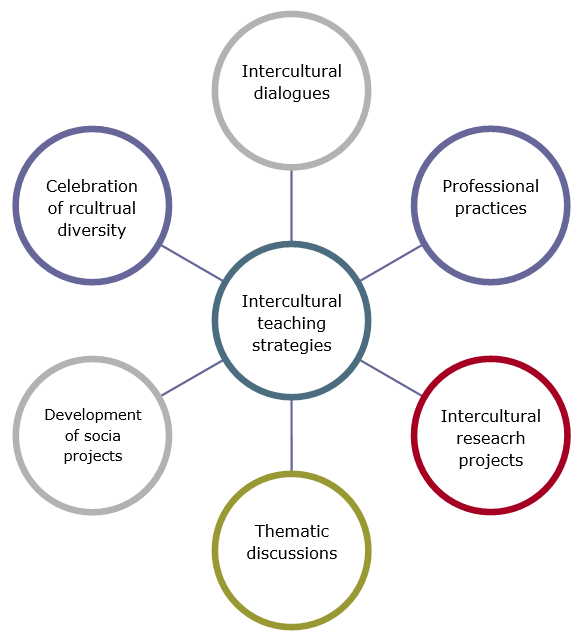
Note. Results of the interview conducted with 10 students and 8 faculty members from the Social Woks program
As shown in Figure 1, five intercultural pedagogical strategies can be identified as predominant in the responses of the interviewees. The first relates to the use of intercultural dialogues, understood as «a regulatory ideal that provides us with a guiding principle. But it is more than an ideal. It is a historically possible utopia as long as we do not forget that the flip side of dialogue is conflict» (Tubino, 2022, p. 4)
This strategy often manifests itself in classroom interactions, where the exchange of knowledge and learning focused on various topics is strengthened. One of the research participants stated that they have initiated conversations based on cultural themes; in this way, interculturality is recognized as a key factor for community intervention; furthermore, considering that, in the course of their professional lives as social workers, they will encounter individuals, families, groups, and communities from diverse cultures—relationships in which respect, empathy, and understanding toward others play a fundamental role.
Other professors interviewed mentioned that they have heard of or are familiar with these methodologies but do not incorporate them into their courses; however, they indicated that they would like to incorporate intercultural dialogues into the activities of the current semester. In the interviews conducted, most teachers agreed to incorporate these strategies into their curriculum in order to understand the social realities of the local communities.
According to the participating students’ perspectives on the intercultural teaching strategies used by instructors, it is necessary to incorporate content that addresses interculturality. One student noted that, given that they live in a department like Putumayo, the university must strengthen this aspect in order to train professionals who recognize and embrace the region’s cultural richness.
Another student specifically stated:
In our research methodology class, we did discuss interculturality, because the professor told us to think of a topic that was close to our hearts, and most of us thought of cultural loss—the loss of the mother tongue and the traditions of indigenous peoples. From there, a discussion arose about what we proposed to research. (Student 4, personal communication, August 15, 2024)
For their part, 6 students stated that intercultural topics are not often discussed. They emphasized that professors do not recognize the importance of learning about the different cultures within the department and the country. In contrast, 4 students stated that, on occasion during their academic career, they had the opportunity to engage in dialogue, learn about, and interact with different cultures within the courses they took.
In this context, it is worth noting that interculturality facilitates the exchange of:
Knowledge, the exchange of ideas, and harmonious coexistence, as equality is one of its core ideals. The commitment to an intercultural approach in higher education fosters an interest in learning about new experiences and practices that can enrich academia through the exchange of knowledge, while also ensuring social inclusion. (Ramos, et al., 2024, p. 182).
This highlights the importance of fostering dialogues that promote intercultural understanding within the classroom; in this particular case, because the institution of higher education is located in a department with great cultural diversity in terms of its indigenous and Afro-Colombian communities. Therefore, the implementation of this strategy will foster a strong sense of social responsibility among faculty and students committed to their region and community.
The second strategy involves the development of social projects aimed at interacting with and engaging different cultures. On this point, both students and teachers emphasize that they have received, shared, and implemented proposals targeting ethnic populations. Most of the interviewees stated that these actions are related to professional internships, in which the students themselves propose intervention projects in contexts located in the department of Putumayo. In these cases, faculty members advise and support these proposals throughout the internship process.
On the other hand, one professor stated: «So far, I haven’t developed any social projects because my course focuses on epistemology, and we cover more theory regarding the acquisition of knowledge and its various representations from a philosophical perspective» (Instructor 2, personal communication, August 16, 2024).
A student stated that, indeed, the professional internship process has led them to develop intervention strategies with different cultures and to understand the multicultural nature of their region. However, within the curriculum covered so far, the importance of interculturality has not been emphasized.
At the University, this strategy is addressed through the different stages of the Social Work program’s curriculum. In the first phase, the focus is on the theoretical foundations of the discipline during the initial semesters; in a second phase, it promotes the formulation and implementation of social projects in a specific course and during professional practice; and, in a third phase, it is noted that one of the pedagogical techniques most frequently used by instructors is debate, which allows for addressing class content and encouraging students to develop their own opinions, perspectives, and critical stances. However, only two teachers have explicitly incorporated an intercultural approach into their courses; they believe that doing so promotes the recognition of cultural diversity and the exchange of knowledge in the classroom:
Discussions are a great way to learn about students’ perspectives on topics such as interculturality, which is both visible and significant in Mocoa and the rest of Putumayo. In group and community work, a professional need to understand these contexts to know how to interact, and discussing this in class has been interesting for both me and the students. (Teacher 4, personal communication, August 16, 2024)
One of the teachers interviewed stated that the use of debate is a relevant pedagogical strategy for critical reflection on social realities. For this reason, he has implemented it in his classes through topics related to multiculturalism and ethnic diversity, with an emphasis on cultural rights. However, he noted that the results were not as expected due to low student participation during the activity, a situation that led him to rethink and strengthen his approach to the topic in order to promote understanding among the entire group.
For their part, the students interviewed confirmed that, throughout their educational journey, they have participated in debates related to these topics, which they consider highly relevant for understanding the experiences of cultures different from their own. This experience had a positive impact on their recognition of and respect for the traditions and customs of people from regions with a rich cultural and ancestral heritage.
Similarly, the celebration of cultural diversity is highlighted as a fundamental strategy for fostering social and cultural inclusion both inside and outside the classroom. The teachers interviewed mentioned that they have organized events on campus, though these have been relatively few in number, because the university has been adapting to local dynamics since 2019, the year it began its educational program in Putumayo.
One of the interviewees, who oversees the degree program selection process, stated that, on several occasions, they have supported and facilitated processes of intercultural celebration; however, one of the most significant was advising a participatory action research project that explored the perception of feminine beauty among Afro-Colombian female students at the Fundación Universitaria Cervantes San Agustín. This research culminated in a photography exhibition, the result of the research process.
Another faculty member stated:
In the course I teach, each semester we produce documentaries on social issues, conduct interviews, and gather information together with the students, which has brought attention to ethnic traditions and the celebration of indigenous Colombian women. (Professor 2, personal communication, August 16, 2024)
Along these same lines, 3 of the students interviewed confirmed that they had participated in at least one of the events mentioned. The remaining interviewees stated that they were unaware of or had not had such experiences of cooperation in celebrating diversity within the school.
The celebration of cultural diversity underpins an important principle for fostering the exchange of knowledge, worldviews, and traditions through interculturality within educational contexts, because «when integrated as a pedagogical strategy aimed at strengthening cultural self-esteem, the positive visibility of identities, and the development of a multicultural curriculum» (Carrasco-Campos, 2025, p. 8) it fosters recognition of others and their cultures through classroom learning.
The final finding pertains to the implementation of practices related to interculturality within the courses offered in the Social Work program. In this regard, participants’ responses were taken into account; the faculty members responsible for guiding this process stated that, when students enter field placements, they encounter dynamics specific to the local context, which allows them to identify social issues that lead to reflection and understanding, enabling them to intervene appropriately in each of the situations presented.
In the words of one of the professors who supervises the practicum: «In my experience, I have encountered several social work intervention projects that address intercultural issues, because most of the social programs carried out here in Mocoa incorporate cultural, inclusive, and diverse elements» (Faculty Member 7, personal communication, August 16, 2024).
Other faculty members in the Social Work program noted that they had not proposed or carried out internships related to this area. However, they do not rule out the possibility of including this content in their academic activities.
For their part, the participating students explained fundamental aspects of their practical learning experience, noting that they were the ones who proposed the intervention with ethnic populations, as this is a topic of interest given the geographical location in which they find themselves. In this regard, one student stated:
I did an internship at a bilingual school in Mocoa, and there we were able to immerse ourselves in the diversity that exists there. The school had an indigenous, Afro-Colombian, and migrant community, so we proposed an inclusive project based on the exchange of worldviews in school settings to promote healthy coexistence in bilingual school environments. (Student 7, personal communication, August 15, 2024)
In this context, 3 of the students have identified interculturality as an important source of research and intervention in social work. In contrast, seven students stated that, as part of their academic studies, they have not received information or encouragement to focus their practice on cultural issues within the region and the country.
After analyzing the comments made by faculty and students regarding the curriculum and tools developed in their professional training, it is concluded that the courses in which interculturality predominates are Research Methodology, Research, Senior Capstone, Professional Practicum, and Group and Community Intervention. These courses address intercultural themes that encourage the exchange of knowledge between students and teachers. A clear example of this, in the research courses, is the senior projects focused on mother tongue, traditional clothing, self-governance, social interactions from the perspective of culture and society, indigenous worldview, Afro-descendant culture in southern Colombia, and cultural and sustainable practices of Afro-descendant and indigenous peoples, among others.
With regard to the intervention courses (professional practice, group intervention, and community intervention), several projects have been proposed and supervised that integrate ancestral knowledge with social work training, with a focus on human and cultural rights. These projects highlight the importance of intercultural pedagogical strategies applied in the classroom, as students can gain a deep understanding of sociocultural realities through an appreciation and respect for cultural diversity. Consequently, social projects have been implemented on health care with a differentiated approach, participatory assessments in ethnic communities, intercultural education in the region, intercultural community development, collective memory, and cultural identity in children and adolescents, among others.
After investigating each of these aspects from the perspective of teachers and students, the research findings contribute to improving aspects related to pedagogy, strategies, and the use of educational resources. In turn, they help train social workers with a critical and respectful view of cultural diversity.
Discussion
The training of social workers presents significant challenges in building a just society. Therefore, emphasizing interculturality is essential for generating new perspectives within the educational sphere, so that what is taught can be applied in professional practice.
Intercultural pedagogical strategies in university settings contribute to the commemoration of historical events and the celebration of peoples’ customs, heritage, and traditions. These practices foster the creation of safe and intercultural environments where both students and faculty can learn about, respect, and interact in culturally diverse contexts, ensuring that the teaching and learning process in higher education is meaningful and enriching for all stakeholders.
In this regard, the Fundación Universitaria Cervantes San Agustín, through its mission, reflects its commitment to «the comprehensive education of individuals with an ethical, interdisciplinary, critical, innovative, and inclusive perspective, through the acquisition and generation of knowledge that promotes academic excellence and contributes to national and global development» (Misión Unicervantes, n.d.). Thus, the institution recognizes respect, commitment, and development as fundamental pillars; in this sense, interculturality in the classroom is not an isolated element but a cross-cutting practice manifested through intercultural pedagogical strategies, which have driven the research interest of this study.
The adoption of intercultural pedagogical strategies fosters a sense of belonging to the local community and context-specific social intervention. Therefore, implementing specific measures—such as curriculum content that recognizes local knowledge, strengthening intercultural institutional policies, and teacher training with an intercultural focus—will ensure the material and symbolic conditions necessary for the training of future social work professionals.
On this topic, Vergara (2021) states:
It is essential for building an inclusive and equitable educational system that responds to the cultural diversity of students, as interculturalism recognizes and values cultural differences, promoting the inclusion of diverse traditions, values, and learning styles in the educational environment. (p. 19)
This contribution prompts a profound reflection on equity and equal opportunity, as well as on diverse experiences and understandings of reality within the context of education.
On the other hand, the study identified issues related to a lack of knowledge and experience regarding these topics. This has led to phenomena associated with limited engagement with and understanding of the social and territorial realities of populations belonging to ethnic groups. However, it was also observed that teachers, at some point in their academic work, have addressed interculturality, though not as a frequent topic, which requires greater attention in teaching and learning processes.
The importance of implementing intercultural pedagogical strategies and resources lies in the fact that interculturality is linked to many aspects of individuals’ environments. In this sense, this approach views diversity as «inherent to human beings and understands social complexity as the recognition that this diversity is dynamic and constructed intersubjectively, that is, through the relationships and communication among people embedded in specific contexts and groups» (Melero and Manresa, 2022, p. 126)
In this context, the teaching work within the Social Work program stands out, particularly due to the essential link between the use of teaching resources and the implementation of educational strategies related to interculturality. These practices facilitate the identification, intervention, and evaluation of social issues in accordance with sociocultural contexts, from a comprehensive, ethical, and respectful perspective. Consequently, it is essential to promote the continuous updating and innovation of the pedagogical tools used in the classroom.
Thus, exploring and experiencing interculturality in the field of higher education constitutes a significant challenge for those involved in teaching and learning processes. This challenge has fostered an openness aimed at encouraging both students and faculty to build new knowledge related to the cultures of the region, the country, and the world. In this context, education plays a fundamental role in training professionals with environmental, social, and cultural awareness, especially in a country characterized by its great diversity, such as Colombia, where it is a priority to ensure safe and dignified spaces that promote equality, equity, and the transformation of the social realities of the communities served.
Finally, the study highlights students’ interest in bringing intercultural contexts to the forefront both inside and outside the classroom. It also demonstrates that engaging with these topics is crucial for accessing and remaining in higher education, as students face a change in context and encounter new cultural environments.
Conclusions
This research presents relevant insights for improving intercultural academic dynamics in higher education, as it largely addresses the resources, tools, and pedagogical strategies implemented in higher education institutions located in ethnic territories.
This study is grounded in recognition, dialogue, and respect among cultures within the educational process of social workers, which is essential for promoting equity, inclusion, and the collective construction of knowledge both inside and outside the classroom. In this sense, intercultural pedagogical strategies are not limited to the inclusion of cultural content in the curriculum, but rather involve the transformation of teaching and learning approaches, oriented toward the appropriation of knowledge from an intercultural perspective.
On the other hand, it is important to note that teachers rarely incorporate educational resources related to interculturalism, such as texts, teaching materials, digital platforms, spaces for cultural interaction, and teaching methodologies. This leads to a lack of awareness of real-world, contextualized issues facing the department, the country, and the world. However, the effectiveness of these resources depends on institutional commitment and that of the teaching staff, because incorporating them into the classroom involves promoting inclusive learning, designed with and for the participation of diverse communities, that allows for an in-depth understanding of the particularities of each cultural space.
According to the research conducted, the use of intercultural pedagogical strategies can vary depending on the perspectives of students and teachers. Thus, some tools used are viewed as key methodologies for integration, equality, and equity; however, others are seen as challenges or shortcomings, as a result of limited teacher training and scant academic interest in addressing this topic.
El contraste de las perspectivas desde la visión del estudiantado y del cuerpo docente del programa de Trabajo Social reveló la necesidad de una formación continua, implementación de politicas educativas y pertinencia de la pedagogia intercultural, que respalde los procesos de enseñanza y aprendizaje como un eje central de la interacción cultural, social e inclusiva.
Conflicto de interés
The author declares that there is no conflict of interest regarding the publication of this article
Ethical responsibilities
This research was conducted with due regard for various ethical considerations, with the aim of ensuring respect for and protection of the participants, as well as the integrity of the research process. To this end, informed consent was obtained and approved by the Academic Coordination Office of the Fundación Universitaria Cervantes San Agustín, which authorized the participation of the interviewed faculty members and students. Likewise, the confidentiality and anonymity of the information were guaranteed; participants were informed that their participation was voluntary and that they could withdraw from the study at any time without any consequences. Responses were treated anonymously and used exclusively for research purposes. Similarly, the research was conducted with full respect for the cultural sensitivities of the Indigenous and Afro-Colombian students. In this regard, the data collection instruments were designed to be culturally relevant and understandable, avoiding any type of bias or discrimination. Finally, efforts were made to minimize any risk of physical or psychological harm, and an atmosphere of respect, consideration, and collaboration among the participants was maintained at all times.
Sources of financing
The author declares that she received no financial support for this work.
References
Ángeles Hernández, E. (2023). Multiculturalismo, multiculturalidad e interculturalidad. una aproximación a sus significados [Multiculturalism, multiculturality, and interculturality: an exploration of their meanings]. Revista Inclusiones, 11(1), 94–114. https://doi.org/10.58210/inclu3492
Carrasco-Campos, Á. (2025). Educación y diversidad cultural. Enfoques, características y fundamentos [Education and cultural diversity: approaches, characteristics, and foundations] [Material docente]. Zenodo.
Epia Silva, M. A. y Arcos Chaparro, I. A. (2024). Pedagogía y didáctica decolonial: un camino hacia la paz intercultural en las comunidades étnicas de Colombia [Decolonial pedagogy and didactics: a path toward intercultural peace in Colombia’s ethnic communities]. En R. Simbaña Q. (Ed.). Elementos de educación: entre la innovación didáctica y la reflexividad profesional (pp. 20-46). Religación Press-Atik Editorial. http://doi.org/10.46652/religacionpress.141.c98
Gómez García, L. M., Gutiérrez-Santiuste, E. y Moreno-López, I. (2021). La videoconferencia: recurso educativo para promover la educación intercultural entre los estudiantes [Videoconferencing: an educational tool for promoting intercultural education among students]. Profesorado, Revista de Currículum y Formación del Profesorado, 25(2), 213–236. https://doi.org/10.30827/profesorado.v25i2.8265
Gómez-Hernández, R. E. (2022). Trayectorias de la interculturalidad en la intervención social de trabajo social [Pathways of interculturality in social work practice]. Prospectiva Revista de Trabajo Social e Intervención Social, (34), 61-83. https://doi.org/10.25100/prts.v0i34.12106
Gómez Hernández, E., Mazo Osorio, A. F., Uribe Cardona, E. P., Morales Mosquera, M. E., Aristizábal Salazar, M. N., Castaño Galeano, A., Vásquez Arenas, G., Muñoz Franco, N. E., Zapata, Á. M., Jiménez Ortiz, E. A., Andrews J. T., Vargas Rodríguez, L., Madrigal Paniagua, M. E., Montiel Olivas, K. V., Solano Chacón, M., Abarca Oviedo, E., Alpízar Ruiz, V., Castro Aguilar, K., González Cordero, S., …, Ballesteros Gallo, S. (2020). Ética intercultural y decolonial de trabajo social [Intercultural and Decolonial Ethics in Social Work]. Pulso & Letra.
Morales, M. E. (2020). Diversidades sociales: una apuesta ética en Trabajo Social [Social diversity: an ethical commitment in social work]. En C. León y M. Orozco (Ed.), Ética intercultural y decolonial de Trabajo Social (pp. 39-48). Pulso & Letra.
Hernández González, O. (2021). Aproximación a los distintos tipos de muestreo no probabilístico que existen [An overview of the different types of non-probabilistic sampling]. Revista Cubana de Medicina General Integral, 37(3), e1442. https://revmgi.sld.cu/index.php/mgi/article/view/1442
Hernández Sánchez, I. B., Lay, N., Herrera, H. y Rodríguez Borbarán, M. (2021). Estrategias pedagógicas para el aprendizaje y desarrollo de competencias investigativas en estudiantes universitarios [Teaching strategies for learning and developing research skills in college students]. Revista de Ciencias Sociales, 27(2), 242-255. https://doi.org/10.31876/rcs.v27i2.35911
Jara, R. J. (2021). Estrategias pedagógicas con tecnología en la enseñanza de la escritura académica universitaria: una revisión sistemática [Teaching strategies using technology in university academic writing instruction: a systematic review]. Revista Digital de Investigación en Docencia Universitaria, 15(1), e1209. https://www.redalyc.org/journal/4985/498571977001/html/
Krainer, A. J. y Chaves, A. (2021). Interculturalidad y educación superior, una mirada crítica desde América Latina [Interculturalism and higher education: a critical perspective from Latin America]. Revista de la Educación Superior, 50(199), 27-50. https://dialnet.unirioja.es/servlet/articulo?codigo=8118291
Martínez Ávila, B. y Álvarez Aguirre, A. (2021). Aplicación de la fenomenología de Amedeo Giorgi como sustento metodológico [Application of amedeo giorgi’s phenomenology as a methodological foundation]. ACC CIETNA: Revista de la Escuela de Enfermería, 8(1), 106-112. https://doi.org/10.35383/cietna.v8i1.570
Gallegos Martínez, G. y Cruz Salazar, T. (2021). Identidades juveniles indígenas: influencia de las transiciones a contextos universitarios y urbanos. El caso de Chiapas, México [Indigenous youth identities: the influence of transitions to university and urban environments. the case of Chiapas, Mexico]. CPU-e, Revista de Investigación Educativa, (32), 33-61. https://doi.org/10.25009/cpue.v0i32.2733
Melero, H. S. y Manresa, A. (2022). Perspectivas sobre educación intercultural e identidad de educadores en formación de posgrado en Ecuador: Lecciones para la formación docente [Perspectives on intercultural education and identity among graduate-level educators in Ecuador: lessons for teacher education]. Diálogo Andino, (67), 124-136. https://www.scielo.cl/pdf/rda/n67/0719-2681-rda-67-124.pdf
Méndez, J. (2021). Universidad, ciudadanía e interculturalidad. Aportes para una pedagogía decolonial [University, citizenship, and interculturality: contributions to a decolonial pedagogy]. Utopía y Praxis Latinoamericana, 26(95), 153-159. https://www.redalyc.org/journal/279/27968419011/html/
Mesa-Manosalva, E. G. (2022). Educación para la cultura de paz en el contexto de Los Pastos, Colombia [Education for a culture of peace in the context of Los Pastos, Colombia]. Revista Electrónica Educare, 26(3), 35-55. https://dx.doi.org/10.15359/ree.26-3.3
Piña-Ferrer, L. S. (2023). El enfoque cualitativo: una alternativa compleja dentro del mundo de la investigación [The qualitative approach: a complex alternative in the world of research]. Revista Arbitrada Interdisciplinaria Koinonía, 8(15), 1–3. https://doi.org/10.35381/r.k.v8i15.2440
Ramos, R. A., Illicachi-Guzñay, J. y Chiriboga-Cevallos, A. A. (2024). Interculturalidad e igualdad en la Educación Superior: una revisión sistemática [Interculturalism and equality in higher education: a systematic review]. Revista Científica Arbitrada de Investigación en Comunicación, Marketing y Empresa REICOMUNICAR, 7(13), 179-206. https://www.reicomunicar.journalgestar.org/index.php/reicomunicar/article/view/242
Rivera Ríos, R., Galdós Sotolondo, S. Á. y Espinoza Freire, E. E. (2020). Educación intercultural y aprendizaje significativo: un reto para la educación básica en el Ecuador [Intercultural education and meaningful learning: a challenge for basic education in Ecuador]. Revista Conrado, 16(75), 390–396. https://conrado.ucf.edu.cu/index.php/conrado/article/view/1436
Sarmiento Berrezueta, S. M., García Gallegos, K. H. y Sacta Lazo, E. F. (2021). Innovaciones pedagógicas en educación intercultural: un desafío para la práctica docente [Pedagogical innovations in intercultural education: a challenge for teaching practice]. Revista Electrónica Entrevista Académica, II(Especial), 121-141. https://dialnet.unirioja.es/servlet/articulo?codigo=7960575
Tubino, F. (2022). Las condiciones del diálogo intercultural según Raúl Fornet-Betancourt [The conditions for intercultural dialogue according to Raúl Fornet-Betancourt]. Utopía y Praxis Latinoamericana: Revista Internacional de Filosofía Iberoamericana y Teoría Social, 27(99), e7091105. https://dialnet.unirioja.es/servlet/articulo?codigo=8587733
Unicervantes Fundación Universitaria. (s.f.). Misión [Mission]. https://unicervantes.edu.co/quienes-somos/
Velásquez Mosquera, A. F. (2021). Cátedra de Estudios Afrocolombianos, escenario académico para propiciar la educación inclusiva e intercultural en Colombia [Afro-Colombian studies department: an academic forum for promoting inclusive and intercultural education in Colombia]. RIDE Revista Iberoamericana para la Investigación y el Desarrollo Educativo, 12(23), e289. https://doi.org/10.23913/ride.v12i23.1063
Vergara Fregoso, M. (2021). De la educación indígena a la educación intercultural en México, Colombia y Guatemala [From indigenous education to intercultural education in Mexico, Colombia, and Guatemala]. Debates, reflexiones y retos. Utopía y Praxis Latinoamericana, 26(95), 11-24 https://www.redalyc.org/journal/279/27968419001/27968419001.pdf
Walsh, C. (2008). Interculturalidad, plurinacionalidad y decolonialidad: las insurgencias político-epistémicas de refundar el Estado [Interculturalism, plurinationalism, and decolonialism: the political-epistemic insurgencies aimed at rebuilding the state]. Tabula Rasa, (9), 131-152. https://doi.org/10.25058/20112742.343
Walker Janzen, W. (2022). Una síntesis crítica mínima de las portaciones de los paradigmas interpretativo y sociocrítico a la investigación educacional [A critical synthesis of the contributions of the interpetative and sociocritical paradigms to educational research]. Enfoques, 34(2), 13-33. https://doi.org/10.56487/enfoques.v34i2.1058
Contribución
Paola Marcela Jurado Erazo: Principal investigator: drafting the Materials and Methods section and obtaining the results; analyzing and interpreting the results; drafting the introduction, methods, discussion and conclusions.
The author prepared the manuscript, reviewed it and approved it.
Research professor, Fundación Universitaria Cervantes San Agustín, Mocoa, Putumayo, Colombia. Email: paolamarjurado@gmail.com