Coexistence management, perception of the coordinator and the school counselor: Phenomenological study
Liliana Esther Molina Isaza1
To reference this article / Cómo citar este artículo / Para citar este artigo: Molina-Isaza, L. E. (2025). Coexistence management, perception of the coordinator and the school counselor: Phenomenological study. Revista UNIMAR, 43(1), 178-195 https://doi.org/10.31948/ru.v43i1.4398
Reception date: September 28, 2024
Review date: November 8, 2024
Approval date: January 21, 2025
Abstract
This article aims to characterize coexistence management in schools from the perspective of school administrators, specifically the coordinator and the school counselor, considering that few studies focus on these two social actors. This study was framed in a qualitative approach, of phenomenological type, and was complemented by a documentary analysis of the formats of coexistence management. Among the main findings, it was identified that school counselors seek to restore interpersonal relationships through listening and dialogue to generate solutions to conflicts of school coexistence; the coordinator, for his part, plays the role of mediator, conciliator, and negotiator. While there is no established model for managing coexistence, the treatment of these cases is still based on a sanction-correction scheme. However, strategies to promote healthy coexistence complement school guidance and coordination. A coexistence management model must have the following characteristics: 1) Integrate management, planning, implementation, evaluation, and monitoring components that strengthen peaceful coexistence; 2) Be based on norms, rules, and laws that regulate the behavior of students and the interaction of the educational community; 3) Formalize management procedures through documents that guarantee due process; 4) Define goals, objectives, and indicators that contribute to the continuous improvement of school life; 5) Be flexible, allowing adaptation to the needs of students’ life and changes in the social environment; and 6) Have a defined focus.
Keywords: managing coexistence; peaceful coexistence; conflict; teaching directive; school counselor; violence
Gestión de la convivencia, percepción del coordinador y orientador escolar: estudio fenomenológico
Resumen
Este artículo tiene como objetivo caracterizar la gestión de la convivencia escolar desde la perspectiva de los directivos docentes: coordinador y orientador escolar, considerando que son pocos los estudios que se centran en estos dos actores sociales. Este estudio se enmarcó en un enfoque cualitativo, de tipo fenomenológico, y se complementó con un análisis documental de los formatos de gestión de la convivencia. Entre los principales hallazgos, se identificó que los orientadores escolares buscan restaurar las relaciones interpersonales a través de la escucha y el diálogo, con el fin de generar soluciones a los conflictos de convivencia escolar; por su parte, el coordinador ejerce un rol de mediador, conciliador y negociador. Aunque no existe un modelo de gestión de convivencia definido, la atención a estos casos sigue basándose en un esquema de sanción-corrección. No obstante, la orientación escolar y la coordinación se complementan mediante estrategias que favorecen la mejora de la convivencia. Un modelo de gestión de la convivencia debe presentar las siguientes características: 1) integrar componentes de la gestión, planeación, ejecución, evaluación y seguimiento que fortalezcan la convivencia pacífica; 2) fundamentarse en normas, reglas y leyes que regulan las conductas de los estudiantes y las formas de interactuar de la comunidad educativa; 3) formalizar los procedimientos de gestión mediante documentos que garanticen el debido proceso; 4) definir metas, objetivos e indicadores que contribuyan a mejorar continuamente la convivencia escolar; 5) ser flexible, permitiendo adaptarse a las necesidades convivenciales de los estudiantes y las transformaciones del entorno social, y 6) contar con un enfoque definido.
Palabras clave: gestión de la convivencia, convivencia pacífica, conflicto, directivo docente, orientador escolar, violencia
Gestão da convivência, percepção do coordenador e o orientador escolar: estudo fenomenológico
Resumo
Este artigo tem como objetivo, caracterizar a gestão da convivência nas escolas a partir da perspectiva dos gestores escolares, especificamente do coordenador e do orientador escolar, tendo em vista que poucos estudos se concentram nesses dois atores sociais. Este estudo foi enquadrado em uma abordagem qualitativa, de tipo fenomenológico, e complementado por uma análise documental dos formatos de gestão da convivência. Entre os principais achados, identificou-se que os orientadores escolares buscam restabelecer as relações interpessoais por meio da escuta e do diálogo para gerar soluções para os conflitos da convivência escolar; o coordenador, por sua vez, desempenha o papel de mediador, conciliador e negociador. Embora não haja um modelo definido para gerenciar a coexistência, o tratamento desses casos ainda é baseado em um esquema de sanção-correção. No entanto, estratégias para promover a coexistência saudável complementam a orientação e a coordenação escolar. Um modelo de gestão da coexistência deve ter as seguintes características 1) Integrar componentes de gestão, planejamento, implementação, avaliação e monitoramento que fortaleçam a coexistência pacífica; 2) Ser baseada em normas, regras e leis que regulam o comportamento dos alunos e a interação da comunidade educacional; 3) Formalizar procedimentos de gestão por meio de documentos que garantam o devido processo legal; 4) Definir metas, objetivos e indicadores que contribuam para a melhoria contínua da vida escolar; 5) Ser flexível, permitindo adaptação às necessidades da vida dos alunos e às mudanças do meio social; e 6) Ter foco definido.
Palavras-chave: gestão da convivência; convivência pacífica; conflito; diretivo docente; orientador escolar; violência
Introduction
The problem that gave rise to this study is that the management of school coexistence is currently based on punitive models that use sanctions and punishments to resolve conflict situations (Torrego, 2006; Dávila Balsera & Naya, 2023). In some cases, the procedures that structure and configure such management are not studied in depth.
Therefore, the central objective of this research was to characterize aspects of the management of school coexistence in public educational institutions in the city of Montería, through the lived experiences of the teaching directors and school counselors involved in the coexistence processes. It should be clarified that the management of school coexistence is considered a fundamental mediating component to efficiently and effectively face the conflict situations that arise in any educational community (Rioseco & Barría, 2021) and should focus on the analysis of the behaviors, experiences, expressions, emotions, and feelings of students, articulated with the regulations and their good attitude towards coexistence, in such a way that school violence or the elements related to it are reduced.
School coexistence is defined as «the action of living with others in the school context peacefully and harmoniously» (Ministerio de Educación Nacional [MEN], 2014, p. 25); Furthermore, it is conceived as a product of the interactions of the members of the educational community, which is structured as a group and dynamically, and changes over time as these interactions change (Rivera et al., 2017). This coexistence includes a continuous construction involving learning in conflict regulation, respect, and collective agreement in the face of different situations (Sandoval, as cited in Cantor, 2018). Coexistence is one of the four pillars of education, as expressed by Delors (1996): «learning to live together» (p. 16). Therefore, coexistence constitutes one of the most important aspects of school activities, complementing each other and academics to comprehensively educate the individual (Nova, 2021).
However, schools are a likely place for conflicts to arise; in these cases, teachers are the first to be called upon to mediate and help students according to each situation and the current regulations. However, the formulation of action plans to direct and organize all the necessary frameworks for an adequate school climate falls to school leaders (Molina, 2023). Thus, according to the MEN (2014), coordinators must promote and foster healthy coexistence and an appropriate climate in the educational institution, under the regulations, rights and duties, incentives, and other rules established in the Coexistence Manual. In this context, it is noted that coordinators generally manage many processes and pay more attention to academics, since educational institutions are measured by the results of external and internal tests, rather than by healthy coexistence. In this sense, the management of coexistence sometimes takes a back seat.
For their part, school counselors play a crucial role in managing school coexistence, as they provide different psychological approaches through which cases can be treated systemically and professionally, recognizing elements that act as protective factors related to comprehensive training (Soto, 2022). According to the MEN (2014), counselors must contribute to harmonious coexistence and promote effective communication and participation in the school community. From their role, they must include integration into institutional processes and application of psychosocial care protocols and routes, establishing timely alerts to develop comprehensive care strategies, and designing plans aimed at preventing psychosocial risks and social problems that affect students.
However, school counselors often lack the support of teachers, parents, and government agencies to monitor students or intervene in situations of social exclusion that warrant it. In addition, in Colombia, the ratio of students to counselors is 1:500, which means that each professional is assigned at least 500 students, and in many cases, this number is exceeded, which overloads them with work and makes it difficult to manage social distancing.
From this perspective, it is worth examining what happens to social actors such as the coordinator and the school counselor, who are part of the phenomenon under study and are protagonists of the educational dynamics and participants in the management of school coexistence. In the study of school coexistence, the focus is generally on teachers and students, and their actions within the coexistence processes are given less importance. Therefore, it is necessary to understand the perspective of the educational reality of teaching directors and school counselors regarding the management of school coexistence.
According to the MEN (2014), there are four relevant actions to manage coexistence in schools: prevention, attention, promotion, and monitoring of conflict situations, constituting the comprehensive care route for coexistence in schools. In particular, coexistence management is a relevant factor in the school context and refers to promoting and maintaining a stable, inclusive, and respectful environment. Its basic objective is to promote harmonious coexistence, cultivate life skills, and pay attention to and monitor problems to prevent conflicts from leading to violence in schools (Molina-Isaza & Nova-Herrera, 2023).
Violence in schools has become a widely studied topic (Galtung, 1998.; Cedeño, 2020), complex, and interesting (Herrera & Frausto, 2021), important at the state level and of concern to the educational community (Saucedo & Guzmán, 2018), It is generated by the inadequate resolution of conflicts due to differences and different positions that are not accepted by the parties (Galtung, 1998). This problem is common in schools, since there is always the possibility of conflict when interacting with others.
In Colombia, by 2023, 70% of students reported having experienced some type of violence at school (Ministerio de Salud y Protección Social, 2023). This index poses challenges to education, its management, and the institutions that drive the processes of coexistence in schools, including the actors involved in the educational reality under study.
Methodology
Focus and design
Qualitative approach, with an interpretive phenomenological design. For Sandín (2003), this is a methodological task that aims at a deeper understanding of social and educational phenomena, the transformation of socio-educational situations and practices, decision-making, and the discovery and formation of an organized structure of knowledge. The fundamental purpose of this type of research, according to Duque and Aristizábal (2019), is that there is a tendency to focus on experiences that acquire a particular meaning, some of which are unusual and have a unique experiential value for those who experience them. In addition, qualitative methods and instruments offer a more comprehensive perspective on social phenomena that are relevant to reality and allow for deeper conclusions to be drawn (Alegre, 2022).
In other words, this study sought to interpret, from the experiences, thoughts, practices, and perspectives of school directors, coordinators, and school counselors, the management of school coexistence and the ways of managing school coexistence —analysis categories— (see Table 1).
Categories and subcategories of analysis
|
Thematic Unit |
Category |
Subcategory |
|
School coexistence |
Characteristics of School Coexistence Management |
Relevance of coexistence management |
|
Attention to school conflicts |
||
|
Prevention of school conflicts |
||
|
Monitoring school conflicts |
||
|
Actions to improve school coexistence |
||
|
Management procedures for resolving school conflicts |
School conflict resolution route |
|
|
School conflict monitoring route |
Note. Based on Molina (2022).
Sample and participating actors
The sample of voluntary participants in the research consisted of six coordinating directors of education, all of them men, and six school counselors, five of them women, for a total of twelve people whose professions are related to the fields of administration, education, psychology, or related fields. According to Sandín (2003), this is an acceptable sample, since qualitative studies usually involve between five and twenty-five participants. The coordinating teachers and school counselors who participated in the interview met the following inclusion criteria 1) permanence in the educational institution for more than three years; 2) directs the coexistence and discipline of the institution within their functions; 3) willingness to provide the forms or documents necessary for the study; 4) the place where they work has the basic secondary and middle level; 5) willingness to respond to the interview. Regarding the exclusion criteria, only two were considered: 1) having less than three years in the institution and 2) not having among their functions, the care of coexistence (see Table 2).
Sample of volunteer study participants
|
No. |
Educational Institution |
Actors participating in the interview |
|---|---|---|
|
1 |
IE Camilo Torres Mocarí |
2 coordinators |
|
2 |
IE Santa María Goretti |
Coordinator Counselor |
|
3 |
IE Nacional |
Coordinator |
|
4 |
IE Mogambo |
Counselor Coordinator |
|
5 |
IE Normal Superior |
Coordinator Counselor |
|
6 |
IE Robinson Pitalua |
Counselor |
|
7 |
IE Rancho Grande |
Counselor |
|
8 |
IE Antonio Nariño |
Counselor |
For a better understanding of the results, the ID identities were organized using distinctive letters and a sequential number as follows: 1) the first two identification units represent the position: Principal (DD), School Counselor (OE); 2) the third unit corresponds to the gender: male (M) or female (F); and 3) the fourth unit corresponds to a consecutive number of the respondents.
Data Collection Techniques and Instruments
The methodological approaches used in this study are based on the contributions of Creswell (cited in Sandín, 2003). Participants were asked to describe their experiences through an in-depth interview using a semi-structured questionnaire (see Table 3)
Questions in each study subcategory
|
Subcategory |
Questions to coordinators |
Questions to School counselors |
|---|---|---|
|
Relevance of coexistence management |
Does the institution have a school coexistence management model? Do you know what criteria were used for its definition? Who participated? Do you think the model is relevant to the situations presented? What limitations does it have? |
Does the institution have a school coexistence management model? Do you know the criteria used to define it? Who participated? From your perspective, which of the processes in school coexistence management (prevention, care, promotion, and follow-up) has the greatest impact on school guidance to ensure healthy coexistence? Do you consider the role of the school guidance counselor to be fundamental in managing school coexistence? Why or why not? Do you think the model is relevant to the situations that arise? What limitations does it have? |
|
Preventing School Conflicts |
What are the main strategies used to prevent school conflicts and promote healthy coexistence? |
What mechanisms or strategies are used in school counseling to prevent school conflicts and violence? |
|
Attention to school conflicts |
What is your role as coordinator in the processes for addressing conflict situations in the educational institution? When you address a conflict situation, do you consider the reasons, moods, and situations the student is experiencing? What methodological approach is used to address conflict or violent situations in the educational institution? Who is involved in each process? |
What conflict resolution processes are handled at the educational institution? Who is involved? When you address a conflict situation, do you investigate the student’s motives, moods, and circumstances? |
|
Monitoring School Conflicts |
Is there any follow-up on conflict situations or students who are repeat offenders? What strategies and formats are used? |
What strategies do you use to monitor conflict situations or students who are repeat offenders? |
|
Promoting healthy coexistence |
What activities and strategies are school administrations advising on to promote healthy coexistence within the educational institution? |
What actions are being implemented at the institutional level to improve school coexistence? |
Note. Based on Molina (2022).
On the other hand, a qualitative content analysis was carried out, as it is a «research technique that aims to formulate, from certain data, reproducible and valid conclusions that can be applied to their context» (Krippendorff, 1980/1990, p. 28). The qualitative documentary review was applied to the formats and protocols used to deal with situations of conflict, indiscipline, or cases of pupils misbehaving and hindering an environment conducive to learning and social interaction, which are also evidence of systematic and progressive work to improve coexistence in the school.
Stages of the investigation
The development of the methodology was carried out based on what was proposed by Duque and Aristizábal (2019) (see Figura 1).
Stages of the interpretive phenomenological study

In the first phase, the focus was on the educational institutions and the principals and counselors to be interviewed. In the second stage, the central research questions were formulated: What are the characteristics of school coexistence management in public educational institutions in Montería? And what are the ways of managing school coexistence in public educational institutions in Montería? These determined the organization of the questionnaire questions, which were submitted to an expert for evaluation. The third stage focused on data collection, through a semi-structured interview with school coordinators and counselors.
In the fourth step, the interviews were transcribed using different methods, and significant aspects were also noted. Subsequently, emerging themes or codes were identified, considering their importance and frequency in the responses, which were grouped according to their relationships (Hernández et al., 2014). A table was also created, bearing in mind the overarching themes and the themes grouped into subcategories according to their relationships. The emerging themes were derived from the data analysis, which prompted discussions and interpretations that contrasted with the frame of reference used in this study (see Figure 2).
Management of school coexistence
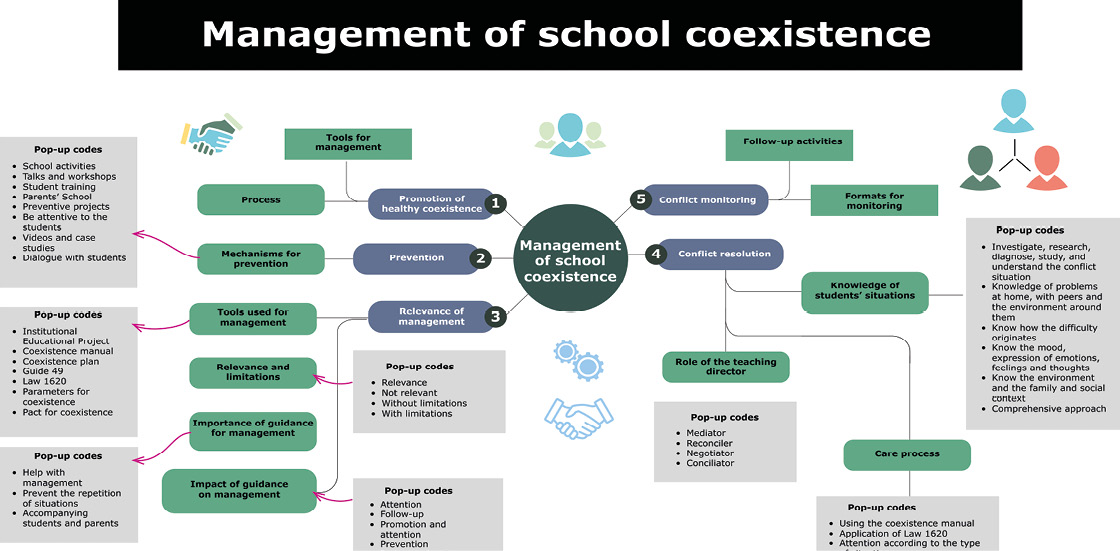
This approach enriched the process and minimized bias in the data. Internal reliability, consistent with the first research objective, was demonstrated in the results obtained through data triangulation (Molina, 2022), which involved contrasting information and methods. These comparisons proved useful in limiting the impact of inappropriate extrapolations and hasty conclusions.
In the fifth stage, the results were written up, and narrated according to the emerging themes found, and some examples of the stories of the participating actors were captured. In the final stage, the contribution of the approach was evaluated and a phenomenological report of the results was presented.
Results
The results of a qualitative study using phenomenological approaches are presented. The first finding relates to the general characteristics of a school coexistence management model in public educational institutions in the city of Montería; the second finding relates to the coexistence management procedures related to the management of conflict situations.
- Characteristics of school coexistence management
The management of coexistence in schools was characterized by subcategories of analysis according to the perspective of school coordinators and counselors, who shared their experiences on the relevance of managing coexistence, preventing and addressing school conflicts, promoting healthy coexistence in schools, and monitoring school conflicts (see Tables 4, 5, 6 y 7).
Relevance
|
Relevance of school coexistence management |
|---|
|
Educational institutions did not have a defined school coexistence management model but they did have tools such as Coexistence Manual, Coexistence Plan, Coexistence Protocols, Coexistence Functions, PEI, Guide ٤٩, Coexistence Parameters, Coexistence Pact (emerging codes); however, from their functions, these direct the procedures and activities for the attention, promotion, monitoring, and prevention of school conflicts. «The word model is not used, but here we have our Coexistence Manual and it is directed by Law ١٦٢٠ on school coexistence» (DDH٢, personal communication). «We don’t have a model as such; we have parameters for some things, for some situations that arise in the institution amid coexistence» (OEM٨, personal communication). The coordinators report that although there is no established model for managing coexistence, in some cases the rules, strategies, plans, and the coexistence manual are relevant to the institution because they show results in improving coexistence in schools. The intervention of governmental organizations is limited because of the lack of support in Type III situations, such as sexual abuse, suicide attempts, and drug use and sales. On the other hand, school counselors stated that the coexistence management model or actions to deal with school conflicts were not relevant due to internal and external variables of the institution. «I think all models have limitations. We try to work in an integrated way, but sometimes we find variables like parents who don’t contribute much» (OEM١٠, personal communication). «One of the limitations is that the model is generalized; it is not particular and cannot be studied in individual cases» (OEM٨, personal communication). The limitations are imposed by the law itself; for example, if a Type III case arises, we must immediately refer it to either the ICBF, Child and Adolescent Protection Agency, the Child and Adolescent Police, or the Family Police Station; then, we immediately disconnect from the case. (DDH3, personal communication) |
|
From the counselors’ point of view, the coexistence management procedures that have the greatest impact on their role are care monitoring or promotion; others coincide in prevention or promotion, and the rest, influence all processes. «There is more work to be done, but I believe, to be honest, that where there is more participation and dynamism, I think it is in the attention; from my perspective, it is in the attention at the moment» (OEM7, personal communication). «I think that follow-up because sometimes promotion is good, but I feel that it doesn’t give as much result as when you follow up on situations with students» (OEM8, personal communication). «Promotion and prevention are very important; the goal is to prevent situations from arising, always working for healthy coexistence, respect, and tolerance» (OEM9, personal communication). School counselors also emphasized the importance of their role in managing coexistence in schools, as they help prevent conflict situations from recurring or becoming more complex by supporting students and parents in the coexistence process and working with the community. «Essential; we send weekly messages from the school leadership so that the students have a sense of support, even though they are at home in this virtual environment» (OEM9, personal communication). Although there is no defined model for managing coexistence, principals and school counselors tend to adopt a normative approach, following what is established by law. This implies a more punitive approach, as it has shown positive results in some cases and not in others. It is worth noting that government agencies have had difficulties in dealing with situations such as abuse, hallucinogen use, and violence due to a lack of follow-up on the cases, the environment, and the students’ families. |
Prevention
|
Prevention of school conflicts |
|
There are a variety of strategies and mechanisms used by both school coordinators and school counselors to prevent conflict at school. These include prevention activities, lectures and workshops, student training, parenting schools, prevention projects, monitoring of student difficulties, use of videos and case studies, implementation of student mediation programs in the classroom, inclusion of prevention strategies in the coexistence handbook, preventive work in the classroom, and ongoing dialogue with students. «Both the teachers and we, the administrators, are attentive to the students; I am even more so since I am in the Coexistence Department; we are attentive to the difficulties the child has» (DDH2, personal communication). |
Attention
|
Attention to school conflicts |
|
The role of the coordinating school principal in resolving school conflicts is focused on the mediation of coexistence situations, negotiation, facilitation of reconciliation processes, and the exercise of arbitration. «Ensure the welfare and well-being of students through reconciliation processes that lead to friendly and cordial treatment among them» (DDH٦, personal communication). To understand the reasons, moods, and situations that students face, school leaders and counselors need to inquire, investigate, and diagnose their context. This includes understanding the nature of the conflict, problems at home, relationships with peers, and the environment. It is also necessary to analyze the origin of the difficulty, assess their emotional state, the expression of their feelings and thoughts, and their family and social environment. All of this allows for a comprehensive approach to addressing situations in the school environment. «In school counseling and in the coexistence section, we don’t limit ourselves to the situation of what happened; we go further, we do individual intervention; we always ask about the student» (OEM٧, personal communication). Regarding the methodological route or procedures used to address situations of conflict or violence at school, the counselors and coordinators agreed on the use of the following mechanisms: standards established in the Coexistence Manual, Law ١٦٢٠, regular channel, internal or external route, institutional actors involved in addressing conflict situations, institutions and organizations that influence the care, and finally, the involvement of parents and reporting the situation. «Depending on the nature of the situation, route ١٦٢٠ is activated so that the appropriate treatment is given to said case» (OEH١١, personal communication). «If the situation arises in the classroom, we have established regular procedures that are clearly outlined in the Coexistence Handbook» (OEM٨, personal communication) |
Promotion
|
Promotion for healthy coexistence |
|
The strategies and measures to be implemented at the educational level, both at the level of coordination and at the level of teaching to promote living together at school, include the following: working as a team to live together, dialogues, projects, or moral education, school programs, talks with students, and training activities. «We are constantly going into classrooms; we always have the spaces available to address this topic through talks and workshops» (OEH12, personal communication). Well, to promote healthy coexistence, activities that go hand in hand with the purpose of the institution are carried out, which is to promote fraternity and camaraderie among students, such as the Week of Peace, Love and Friendship, a song festival, among others. (OEM10, personal communication) |
Table 8
Monitoring
|
Monitoring school conflicts |
|
In this process, the commitment of students to change their attitudes toward school life is essential. This process is achieved through regular, lifelong learning and monitoring to improve their behavior. Various recording formats are also used, including the following: situation formats, dialogue reports, educational sanctions, disciplinary commitments, conditional enrollment, cumulative student records, disciplinary forms, student observers, and follow-up formats. If the student is being monitored, the first step is to ensure the situation doesn’t happen again. A disciplinary form is used and the student must sign it with the parent. If a conflict warrants involving the parent, the parent must be involved. (DDH1, personal communication) |
2. Coexistence management procedures related to the handling of conflict situations.
By reviewing the documents of the formats used to deal with conflict situations, it is possible to verify actions demonstrating the management of coexistence within educational institutions through two defined procedures: 1) attention to school conflicts, and 2) monitoring of school conflicts.
Attention to school conflicts
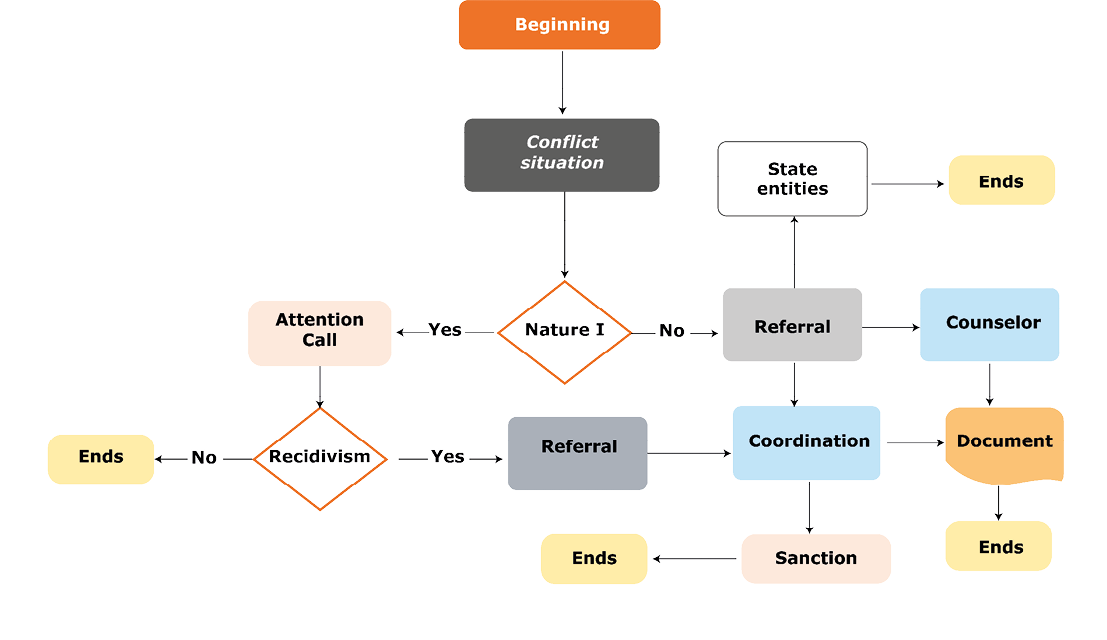
The procedures for dealing with situations that affect coexistence in Colombia are based on the response path provided for in Law 1620 of 2013 and its Decree 1965 of 2013. This law presents three types of situations: Type I, Type II, and Type III. In educational institutions, Type I situations are generally handled in the classroom by teachers, who give a verbal warning; however, if the student recurs, the coordinator takes the case based on a prior report from the teacher. In addition, in the case of school violence, any teacher, principal, or counselor can reprimand students or mediate the conflict.
If conflicts remain unresolved and violence occurs through physical, psychological, or verbal aggression, if it is systematic, the conflicts will be addressed by the Coordination Team and referred to the School Counselor. If there is physical harm without disability or cyber-related harm, they become Type II situations and are referred to an appropriate government agency depending on the severity. In these cases, the Care Route Protocols will be considered following the law.
If the condition is a Type III situation, it is immediately referred to the government agencies responsible for the safety of children and adolescents. In this case, the following documentation must be provided: cohabitation situation forms, dialogue protocols, educational sanction forms, and disciplinary commitment forms. It should be noted that the names of each form vary from institution to institution, but their purpose is the same: to improve the student’s behavior. In terms of care, parents should be informed of the situation their children are facing, as they play a very important role in reinforcing positive behaviors at home (see Figura 3).
Procedimiento de atención
Note. Based on Molina (2022).
Monitoring school conflicts
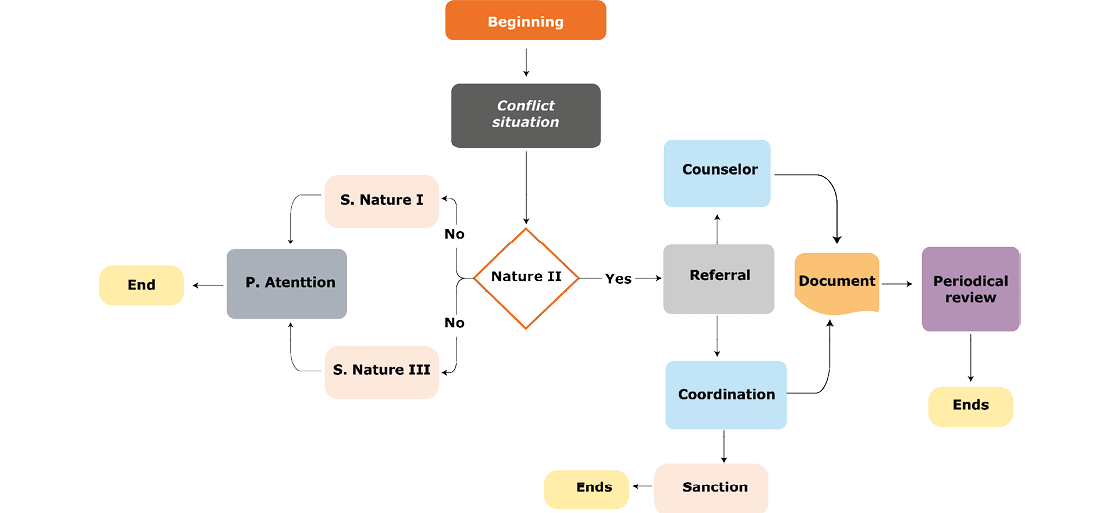
The follow-up procedures are based on dealing with conflict situations; they differ from these in that the problem is reviewed periodically; generally, they deal with Type II and III situations. In addition, the intervention of the school counselor is more frequent and depends on the commitments made by students and parents, whose purpose is to guarantee the rights of children and adolescents through due process.
This process is characterized by two important aspects: first, the role of the principal and the school counselor in inquiring about their behavior, their daily life at school, and the situations they face in their family and social environment; in other words, the willingness to continuously monitor students with behavioral, emotional, or psychological difficulties so that they improve; second, the responsibility to keep forms or documents that demonstrate the monitoring of situations (see Figure 4).
Monitoring conflict situations
Note. Based on Molina (2022).
The documents used in this context are the Observer or Cumulative Record, the Monitoring Form, and the Conditional Enrollment Form. The Observer or Cumulative Record is designed to provide periodic or repeated descriptions throughout the year of the student’s academic and social life, throughout his or her stay at the institution. That is, it can accumulate information from several years, including monitoring, support, involvement, strengths and weaknesses, and in some cases, physical and psychological aspects; for example, height, weight, disability, etc. Another important aspect is that it contains relevant information about the parents or guardians, such as their details, occupation, and profession.
The follow-up forms specify the student’s repeat offenses and aspects such as commitments and the guardian’s signature to ensure due process. Conditional enrollment forms are the coordinator’s last resort since after the entire coexistence process, carried out with the school counselor in the company of the guardian or parent, this form is legalized under the provisions of the Coexistence Manual and with the support and decision of the Coexistence Committee. This form informs the guardian of the student’s behavior; if the inappropriate behavior continues, the conditional enrollment will be canceled.
Discussion
When studying the management of coexistence in schools from the perspective of school principals and school counselors and after triangulating the information (Molina, 2022), it can be noted that the authors focus their studies on aspects that structure the management of coexistence. From this perspective, it can be noted that there are models of coexistence management that focus on addressing punitive, relational, and integrated conflict situations (Torrego, 2006). Sullivan (cited in Martín et al., 2003), in addition to the punitive, includes consequences and feelings.
For his part, Morales (2022) focuses on the management of coexistence on due process in a circle of dialogue that seeks to guarantee respect for human beings and their rights. However, the reality is that there is no defined model in educational institutions; management has limitations that depend on external agents and generally respond to sanctioning actions and the social environment and its problems, and not to a programmed or directed planning.
On the other hand, some authors frame the management of coexistence in aspects of promotion and prevention, which are generally characterized by being formative (Canchila and Pacheco, 2021; Briceño, 2024; Carvajal and Acebedo, 2019), and directed relating to being, ethics and values, the construction of peace, and citizenship.
Molina (2022), from the emotional approach, considers that the components of attention, promotion, prevention, and monitoring of conflict situations are not mutually exclusive, but rather complementary; she gives equal importance to all the processes that influence the management of coexistence to address conflict situations and reduce violence in schools.
Likewise, Saavedra (2024) explains that in addition to punitive and formative approaches, there are also managerial ones, that is, management actions in directing school coexistence, such as the application of the Plan, Do, Check, Act —PDCA— cycle (Lombana, 2016) ) and the European Foundation for Quality Management (EFQM) model (Ortiz-Padilla et al., 2018), which seek to improve school coexistence systemically. Although educational institutions carry out activities with the same objective of mitigating violence, they are not always part of institutional plans, which shows a lack of management, given the absence of clear objectives and indicators, targets, and evaluation of their impact on school coexistence.
Conclusions
The following aspects define the management of coexistence in schools: 1) it includes elements of management, planning, implementation, evaluation, and monitoring that strengthen peaceful coexistence; 2) it is based on norms, rules, and laws that regulate student behavior and the interaction educational community; 3) it formalizes management procedures through documents to ensure due process; 4) it has goals, objectives, and indicators that continuously improve school coexistence; 5) it is flexible according to the coexistence needs of students and changes in the social environment; and 6) it has a defined approach: ethical-moral, socio-emotional, restorative justice, citizenship, and peace, conflict mediation, democratic participation or punitive and inclusive.
The management of school coexistence in educational institutions is more closely related to the attention and monitoring of school conflicts by school coordinators and counselors since conflict situations between students will always occur. However, it cannot be ignored that prevention and promotion are also important because they can save lives. While counselors and coordinators observe improvements in school climate, they lack indicators to corroborate this information. In addition, they lack clear statistics on the use of psychoactive substances among adolescents, bullying, classroom disruptions, inappropriate behavior, and disrespect for teachers, which demonstrates a lack of systematic understanding of the progress made in school coexistence. This progress is generally measured in terms of students’ reactions to the various activities carried out at school.
One of the management strategies directly related to resolving conflicts between students in educational institutions is the monitoring and follow-up of conflict situations. In conflict resolution, sanctions are still used as a correction, that is, they are punitive. However, other measures are taken to improve the fraternity between those involved in such situations, which is further strengthened through structured training in values, peace, citizenship, democratic participation, and interaction with others.
It’s worth noting that guidance goes hand in hand with school coordination. In the management of coexistence, these bodies complement each other in resolving conflict situations and helping students to complete their educational projects. Both coordinators and guidance counselors are aware of the importance of coexistence for the educational community; therefore, whenever necessary, they jointly develop various strategies, plans, and activities aimed at promoting healthy coexistence.
Conflict of interest
The author declares that she has no conflict of interest that could affect the publication.
Ethical responsibilities
For the qualitative research, semi-structured interviews were conducted with the principals, coordinators, and school counselors who were of legal age and who signed an informed consent form for the collection of data.
References
Alegre, M. A. (2022). Aspectos relevantes en las técnicas e instrumentos de recolección de datos en la investigación cualitativa. Una reflexión conceptual [Relevant aspects of data collection techniques and instruments in qualitative research. A conceptual reflection]. Población y Desarrollo, 28(54), 93-100. https://doi.org/10.18004/pdfce/2076-054x/2022.028.54.093
Briceño, C. E. (2024). Convivencia escolar. Perspectivas desde la orientación educativa [School coexistence: Perspectives from an educational orientation]. Tsafiqui, Revista Científica en Ciencias Sociales, 14(1), 7-25. https://doi.org/10.29019/tsafiqui.v14i22.1171
Canchila, O. L. & Pacheco, M. C. (2021). Convivencia escolar desde la pedagogía de paz: estrategia didáctica a través de la lúdica [School coexistence from a pedagogy of peace: a didactic strategy through play]. Assensus, 6(11), 108-117. https://revistas.unicordoba.edu.co/index.php/assensus/article/view/2716
Cantor, J. J. (2018). “Aula-ciudad”: una apuesta para pensar la convivencia y la ciudadanía en la escuela [“Classroom-City”: A challenge to thinking about coexistence and citizenship in schools]. Ciudad Paz-Ando, 11(2), 72-83. https://doi.org/10.14483/2422278x.13278
Carvajal, W. & Acebedo, M. J. (2019). La prevención del conflicto en la gestión de la convivencia en ambientes escolares [Conflict prevention in the management of coexistence in school environments]. Revista TEMAS, 3(13), 157-171. https://doi.org/10.15332/rt.v0i13.2340
Cedeño, W. A. (2020). La violencia escolar a través de un recorrido teórico por los diversos programas para su prevención a nivel mundial y latinoamericano [School violence through a theoretical overview of the various programs for its prevention worldwide and in Latin America]. Revista Universidad y Sociedad, 12(5), 470-478. http://scielo.sld.cu/pdf/rus/v12n5/2218-3620-rus-12-05-470.pdf
Dávila, P. & Naya, L. M. (2023). La “señal”, un objeto de la escuela disciplinada y de la pedagogía del silencio [The “signal,” an object of the disciplined school and the pedagogy of silence]. Cabás, Revista Internacional Sobre Patrimonio Histórico-Educativo, (30), 19-36. https://doi.org/10.35072/CABAS.2023.28.69.003
Decreto 1965 de 2013. (2013, October 7th). Presidencia de la República de Colombia. Diario oficial 48910. https://www.suin-juriscol.gov.co/viewDocument.asp?ruta=Decretos/1378136
Delors J. (1996). La educación encierra un tesoro [Education contains a treasure]. Santillana - UNESCO.
Duque, H. & Aristizábal, E. (2019). Análisis fenomenológico interpretativo. Una guía metodológica para su uso en la investigación cualitativa en psicología [Interpretive phenomenological analysis: A methodological guide for use in qualitative research in psychology]. Pensando Psicología, 15(25), 1-24. https://doi.org/10.16925/2382-3984.2019.01.03
Galtung J. (1998.). Tras la violencia, 3R: reconstrucción, reconciliación, resolución. Afrontando los efectos visibles e invisibles de la guerra y la violencia [In the aftermath of violence, the 3Rs: Reconstruction, reconciliation, resolution. Addressing the visible and invisible effects of war and violence] (T. Toda, Trad.). Gernika Gogoratuz.
Hernández, R., Fernández, C., & Baptista, P. (2014). Metodología de la investigación [Research methodology] (6.a ed.). McGraw Hill España
Herrera, O. & Frausto, M. (2021). Violencia escolar y mediación pedagógica en estudiantes de educación básica [School violence and pedagogical mediation in basic education students]. Revista Innova Educación, 3(2), 438-453. https://doi.org/10.35622/j.rie.2021.02.010
Krippendorff, K. (1990). Metodología del análisis de contenido. Teoría y práctica [Content Analysis Methodology: Theory and Practice] (L. Wolfson, Trad.). Paidós. (Obra original publicada en 1980).
Ley 1620 de 2013. (2013, March 20th). Congreso de Colombia. Diario oficial 48733. https://www.suin-juriscol.gov.co/viewDocument.asp?ruta=Leyes/1685356
Lombana, J. A. (2016). Construcción de un modelo de gestión de la convivencia escolar a partir de la danza como centro de interés en el colegio CEDID San Pablo de Bosa [Building a school coexistence management model based on dance as a focus at the CEDID San Pablo de Bosa school] [Tesis de maestría, Universidad Libre]. Repositorio Institucional Unilibre. https://repository.unilibre.edu.co/handle/10901/8249
Martín, E., Fernández, I., Andrés, S., del Barrio, C., & Echeita, G. (2003). La intervención para la mejora de la convivencia en los centros educativos: modelos y ámbitos [Intervention to improve coexistence in educational centers: models and areas]. Revista para el Estudio de la Educación y el Desarrollo, 26(1), 79–95. https://doi.org/10.1174/02103700360536446
Ministerio de Educación Nacional (MEN). (2014). Guía Núm. 49 Guías pedagógicas para la convivencia escolar Ley 1620 de 2013 - Decreto 1965 de 2013. MEN. [Guide No. 49 Pedagogical guides for school coexistence Law 1620 of 2013 - Decree 1965 of 2013. MEN.] https://contenidos.mineducacion.gov.co/ntg/men/pdf/Guia%20No.%2049.pdf
Ministerio de Salud y Protección Social. (2023, April 13). La violencia en entornos escolares es una verdadera epidemia [Violence in school environments is a true epidemic]. Boletín de Prensa, (118). https://www.minsalud.gov.co/Paginas/La-violencia-en-entornos-escolares-es-una-verdadera-epidemia.aspx
Molina, L. E. (2022). Modelo de gestión de la convivencia escolar basado en la inteligencia emocional para la resolución de conflictos en instituciones educativas públicas de Montería [A model for managing school coexistence based on emotional intelligence for conflict resolution in public educational institutions in Montería] [Tesis de doctorado, Universidad Metropolitana de Ciencia y Educación UMECIT]. Repositorio UMECIT. https://repositorio.umecit.edu.pa/entities/publication/8d37f247-b5fa-4162-a3f2-15e6bddf8e88
Molina, L. E. (2023). Desafíos actuales de la planificación educativa en Colombia [Current challenges of educational planning in Colombia]. Revista UNIMAR, 41(2), 184-202. https://doi.org/10.31948/Rev.unimar/unimar41-2-art11
Molina-Isaza, L. & Nova-Herrera, A. J. (2023). La inteligencia emocional, una oportunidad para la gestión de la convivencia escolar [Emotional intelligence, an opportunity for managing school coexistence]. Praxis, 18(1), 15-32. https://doi.org/10.21676/23897856.3878
Morales, J. A. (2022). Castigo y sanción en la familia y en la escuela. Retos de una educación sin castigos y de la crianza con amor [Punishment and sanction in the family and at school. Challenges of education without punishments and parenting with love] (2.a ed.). POEMIA
Nova, A. J. (2021). Políticas para la formación integral en la educación superior en Colombia [Policies for comprehensive training in higher education in Colombia] [Ponencia]. Congreso de Investigación y Pedagogía III Nacional II Internacional, Universidad Pedagógica Tecnológica de Colombia. https://repositorio.uptc.edu.co/items/a99af3ab-ae96-4582-ab07-627fded31891
Ortiz-Padilla, M. E., Barros-Moncada, M. C., Ariza-Ortiz, S. M., & Rubio-Castro, R. C. (2018). Gestión de la convivencia escolar: indicador de la calidad en la organización educativa [School coexistence management: an indicator of quality in the educational organization]. Opción, 34(18), 1097-1125. https://bonga.unisimon.edu.co/items/bdc8bfca-43bb-45ae-a475-aaaf707f5158
Resolución 3842 de 2022. (2022, 18 de marzo). Ministerio de Educación Nacional de Colombia. https://www.alcaldiabogota.gov.co/sisjur/normas/Norma1.jsp?i=122207
Rioseco, C. & Barría, R. (2021). Contribución de la dimensión relacional del Clima Social Escolar (CES) a la Convivencia Escolar para la No Violencia (CENVI), desde la percepción de estudiantes de segundo ciclo y enseñanza media en escuelas y liceos municipalizados de Estación Central [Contribution of the relational dimension of the School Social Climate (CES) to the School Coexistence for Non-Violence (CENVI), from the perception of second cycle and secondary school students in municipal schools and high schools of Estación Central]. Rumbos TS, 16(26), 167-190.. https://dx.doi.org/10.51188/rrts.num26.573
Rivera, L. A., Torres, P. Y., & Hernández, P. R. (2017). Estrategia didáctica “escuela para la familia y familia para la escuela” desde el área de las ciencias sociales: Fortalecimiento de la convivencia en los estudiantes de la básica primaria de la institución educativa Cecilia de Lleras [Teaching strategy “school for the family and family for the school” from the area of social sciences: Strengthening coexistence in primary school students at the Cecilia de Lleras educational institution] [Tesis de maestría, Universidad Santo Tomás]. Red Colombiana de Información Científica. https://redcol.minciencias.gov.co/Record/SantoToma2_f98abc702a9e8db6888ee350f4d29437
Saavedra, J. A. (2024). Políticas públicas de convivencia escolar en América Latina: una revisión sistemática desde las directrices PRISMA [Public policies on school coexistence in Latin America: a systematic review based on the PRISMA guidelines]. Discimus Revista Digital de Educación, 3(1), 39-68. https://doi.org/10.61447/20240601/art02
Sandín, M. P. (2003). Investigación cualitativa en educación. Fundamentos y tradiciones [Qualitative research in education: Foundations and traditions]. Mc-Graw Hill
Saucedo, C. L. & Guzmán, C. (2018). La investigación sobre la violencia escolar en México: tendencias, tensiones y desafíos [Research on school violence in Mexico: trends, tensions, and challenges]. Cultura y Representaciones Sociales, 12(24), 213-245. https://doi.org/10.28965/2018-024-08
Soto, S. M. (2022). Orientador escolar y ambientes de convivencia: un tema para reflexionar [School counselor and living environments: a topic for reflection]. Memorias III Congreso Internacional de Educación, Artes y Humanidades 2022 (pp. 63-64). Universidad Francisco de Paula Santander.
Torrego, J. C. (coord.) (2006). Modelo integrado de mejora de la convivencia. Estrategias de medicación y tratamiento de conflictos [Integrated model for improving coexistence. Medication and conflict management strategies]. Editorial Graó.
Contribution
Liliana Esther Molina Isaza: Principal investigator. Statistical data processing, writing materials and methods, obtaining results, analyzing and interpreting results, writing the introduction, methods, discussion, and conclusions.
The author prepared the manuscript, read it, and approved it.
Secretaría de Educación de Córdoba, Montería, Colombia. E-mail: lilianamolinaisaza@gmail.com