Strengthening the school climate in ninth-grade students through social skills
Jimmy Spencer Ramírez Martínez1
José Julio Pereira Mendoza2
Luz Karine Jiménez Ruiz3
To reference this article / Cómo citar este artículo / Para citar este artigo: Ramírez-Martínez, J. S., Pereira-Mendoza, J. J., & Jiménez-Ruiz, L. K. (2025). Strengthening the school climate in ninth-grade students through social skills. Revista UNIMAR, 43(2), 44-59. https://doi.org/10.31948/ru.v43i2.4335
Reception date: August 14, 2024
Review date: February 4, 2025
Approval date: May 21, 2025
Abstract
The main objective of this study was to improve the school climate by strengthening the social skills of ninth-grade students at an educational institution in Valledupar, Cesar. To this end, didactic strategies focused on social skills were implemented, including problem and conflict management, assertive communication, interpersonal relationships, empathy, and critical thinking. Subsequently, the achievements and results of these strategies were assessed and evaluated. Methodologically, the study was framed within a qualitative, participatory action research approach. Observation, questionnaires, interviews, and pedagogical diaries were used to evaluate the effectiveness of strategies applied to improve the school climate. In this context, the strategies applied had a positive impact on the development of empathy, assertive communication, critical thinking, and problem and conflict management skills. This fostered emotional connection and understanding among the students.
Keywords: critical thinking; social skills; school climate; students; empathy; assertive communication
Fortalecimiento del clima escolar en estudiantes de noveno grado mediante habilidades sociales
Resumen
El objetivo principal de este estudio fue fortalecer el clima escolar mediante habilidades sociales en estudiantes de noveno grado de una institución educativa de Valledupar, Cesar. Para ello, se implementaron estrategias enfocadas en habilidades sociales: manejo de problemas y conflictos, comunicación asertiva, relaciones interpersonales, empatía y pensamiento crítico; posteriormente, se realizó una valoración y evaluación de los logros y resultados de la aplicación de dichas estrategias didácticas. Metodológicamente, el estudio se enmarcó en un enfoque cualitativo de tipo investigación-acción participativa. En las técnicas e instrumentos, se utilizaron la observación, el cuestionario, la entrevista y el diario pedagógico, con el fin de evaluar la efectividad de las estrategias aplicadas en relación con el mejoramiento del clima escolar. En este contexto, el impacto de las estrategias aplicadas fue positivo en el desarrollo de habilidades de empatía, comunicación asertiva, pensamiento crítico, manejo de problemas y conflictos. Lo anterior favoreció la conexión emocional y el entendimiento de los estudiantes.
Palabras clave: pensamiento crítico; habilidades sociales; clima escolar; estudiantes; empatía; comunicación asertiva
Fortalecimento do clima escolar em alunos da nona série por meio de habilidades sociais
Resumo
O principal objetivo deste estudo foi melhorar o clima escolar por meio do fortalecimento das habilidades sociais dos alunos do nono ano em uma instituição educacional em Valledupar, Cesar. Para isso, foram implementadas estratégias didáticas com foco em habilidades sociais, incluindo gerenciamento de problemas e conflitos, comunicação assertiva, relações interpessoais, empatia e pensamento crítico. Posteriormente, as realizações e os resultados dessas estratégias foram avaliados. Metodologicamente, o estudo foi enquadrado em uma abordagem qualitativa e participativa de pesquisa-ação. Observações, questionários, entrevistas e diários pedagógicos foram usados para avaliar a eficácia das estratégias aplicadas para melhorar o clima da escola. Nesse contexto, as estratégias aplicadas tiveram um impacto positivo no desenvolvimento da empatia, da comunicação assertiva, do pensamento crítico e das habilidades de gerenciamento de problemas e conflitos. Isso promoveu a conexão emocional e a compreensão entre os alunos.
Palavras-chave: pensamento crítico; habilidades sociais; clima escolar; alunos; empatia; comunicação assertiva
Introduction
In countries such as Colombia, which has faced challenges stemming from violence for many years and where global interconnectedness shapes social dynamics, it is imperative to cultivate positive social relationships in various areas (Gómez, 2019).
In this sense, social dynamics include aspects of dependence on the environment in which individuals operate. One such aspect is linked to the educational sphere. Ramírez and Tesén (2022) analyze the concept of school climate in terms of relationships, specifically among students and teachers, and among classmates. These relationships are influenced by students’ constantly changing and evolving contextual realities.
In this context, the problem of this study focuses on the need to address episodes of indiscipline observed at the beginning of the research, which have affected healthy coexistence and the school climate, specifically in grade 9-2 of an educational institution in Valledupar, Cesar. The study focused on students in this grade, mainly because this course has been reported multiple times to the School Guidance Department for acts of indiscipline.
Based on the above, the following question arose: How do social skills improve the school climate among ninth-grade students at an educational institution in Valledupar, Cesar? The overall goal was to enhance the school climate by improving the social skills of students in grade 9-2 at the educational institution.
The following specific objectives were also established: to describe the school climate of the interaction processes between students in grade 9-2; to design and implement workshops based on social skills, to strengthen the school climate; to assess the effectiveness of conducting workshops aimed at developing social skills as a strategy to improve the school environment for students through a comparative analysis of the situation before and after the implementation of these workshops. According to Herrero (2022), social competence involves utilizing skills that encompass the conscious management of thoughts, emotions, and behaviors.
Rivera (2022) asserts that school coexistence is a partnership among teachers, administrators, families, and students. Through this partnership, respectful and kind treatment is fostered, which is necessary in the early stages of education. According to Ruiz (2022), school climate is defined as the collective perception of educational stakeholders regarding the successful development and functioning of institutional practices. Regarding this topic, López (2021) explains that teachers play an essential role. Their pedagogical actions demonstrate results that contribute to the formation of citizenship and healthy environments where meaningful learning takes place amid healthy coexistence.
In terms of methodology, this study employed a sociocritical interpretive paradigm with a qualitative, participatory action research approach, allowing for a deep and detailed understanding of the dynamics and factors influencing the school environment. Procedurally, classroom observations, interviews, and analyses of teachers’ pedagogical journals were conducted, using questionnaires to gather information about the school climate that students in the selected grade foster.
To develop a clearer understanding of the purpose of this study and ensure a consistent approach, the proposals of Guevara et al. (2020) were considered. Additionally, we ensured that the analysis and conclusions comprehensively addressed the collected information and facts, were theoretically and practically grounded, and provided answers to each objective.
Pérez-Guevara and Puentes-Suárez (2022) emphasize the importance of improving the school climate through social skills-based strategies. They argue that integrating social skills is essential for maintaining and enhancing the school climate because it fosters an environment where students feel safe, respected, and motivated to learn. This positively impacts their academic and personal development.
Ascorra et al. (2003) state that a toxic school climate causes students to lose interest in attending and participating in school programs. As a result, negative attitudes increase, leading to conflict-filled interactions. Similarly, the negative situation is evident in the presence of violence in schools and poor performance, although these are not the only factors that indicate a toxic school environment. According to the Organización de las Naciones Unidas para la Educación, la Ciencia y la Cultura (UNESCO, 2013), when educators neglect students, the students may resist participating in activities that exceed their capabilities. This is just one example of the many attitudes or situations that may arise in school.
School climate
This is the space where the concept of school connection is considered an important starting point for learners to acquire knowledge. Generally, learners’ connection to the educational environment is analyzed within a framework that includes positive student behaviors and connections to the school (Pérez-Guevara and Puentes-Suárez, 2022).
According to López (2021), it is the set of perceptions, attitudes, and relationships that prevail within an educational institution and shape the environment in which academic and social activities occur. It includes factors such as the quality of interactions among students, teachers, and staff, the degree of respect and emotional support, and the effectiveness of conflict resolution and communication strategies. Ruiz (2022) asserts that a positive and safe school climate promotes student well-being and academic performance. Conversely, a negative climate can hinder learning and affect the emotional health of the educational community.
School climate classification
Consistent with the above, it is appropriate to investigate the characteristics of the school climate. According to Arón and Milicic (2000), this can be classified as either a nutritious or toxic environment. In this way, nurturing school environments motivate individuals to participate in school activities, demonstrating a desire to learn and promote healthy interactions and harmonious coexistence.
Social skills
Social skills are behaviors and experiences that govern individuals, helping them manage relationships and respect the rights of themselves and others (Babarro, 2021). According to Esteves et al. (2020), these skills are the specific behaviors and gestures necessary for interacting with and connecting with others in a friendly and successful manner. Monjas (2021), for her part, refers to them as specific behavioral or social skills, important for competently performing interpersonal tasks.
Roca (2014) points out that, in addition to being learned practices and observable behaviors, social skills are also a set of ideas and emotions that contribute to the development of interpersonal relationships. Esteves et al. (2020) added that much social behavior is learned through observation. Therefore, it is a learning process acquired through cognitive representations of modeled behavior, with an emphasis on imitation.
Methodology
The research falls within the interpretive sociocritical paradigm, whose main objective was to transform observed reality about the school climate. The study focused on improving the social skills of students in grade 9-2 at an educational institution in Valledupar, Cesar. Notable skills include empathy, problem-solving, assertive communication, and critical thinking, among others.
The research employed a qualitative, descriptive approach and the pedagogical action research method. According to Niño (2019), this method is based on a comprehensive analysis of the perspectives, situations, and meanings that people attribute to events related to their actions in natural contexts that present challenges to be solved. This approach was chosen based on an analysis of data collection methodologies, which are essential for developing the research (Hernández et al., 2014).
In this regard, Hernández et al. (2014) note that action research is employed when a community is confronted with an issue that requires attention and wishes to implement substantial changes. In this methodology, community members are involved in every stage of the process, from identifying the problem to formulating solutions. The purpose of action research is to empower participants to play a proactive role in the process by making informed judgments based on their understanding of their situation and needs. The idea is that people who are directly affected by a problem gain a deep understanding of their experiences. Therefore, they can contribute valuable perspectives to developing effective, lasting solutions (Niño, 2019).
From this perspective, Niño (2019) emphasizes the importance of highlighting the objective of action research (AR): to promote the development of individuals and groups, particularly in areas such as education, health, social welfare, politics, and administration. Like pedagogical-action research, AR has generated controversy in academic circles due to its departure from conventional research criteria. Using traditional methodologies and approaches without adapting them for AR will likely lead to suboptimal results.
Piñero and Rivera (2015) emphasize that the educational environment is one of the most relevant contexts for this type of research, which is characterized by the active participation of groups involved in specific issues. This allows for a thorough examination of teaching strategies, curriculum content, social values, critical areas of learning processes, attitudes, and classroom dynamics. It covers various topics in the field of education, including its dimensions, methods, and participants.
For this study, a representative sample of 37 ninth-grade students, aged 14 to 15, was selected. Of these students, 22 identified as male and 15 identified as female. These students were included in the study based on teacher reports submitted to the educational coordinator, which indicated that they had been involved in conflictive situations affecting the school climate.
One of the techniques used to collect information was direct observation. According to Martínez-González (2021), direct observation involves taking notes on visual, auditory, and tactile perceptions of the environment and the people or groups being observed. These notes are often organized chronologically and provide a detailed account of events, specifying what happened, who was involved, and when and where it happened.
A semi-structured interview was conducted with teachers. According to Sánchez et al. (2021), in qualitative research, in-depth interviews are conducted through several face-to-face meetings between the researcher and the interviewee. The goal is to explore the interviewee’s perspective and opinion on their life, experiences, and situations they have encountered. This method can be divided into three categories: structured, semi-structured, and unstructured interviews. Individual interviews were conducted with teachers to investigate their experiences and perceptions of coexistence and the school climate with the students of grade 9-2 at an educational institution.
The pedagogical journal was used to collect information. According to Sánchez et al. (2021), a pedagogical journal, also known as a reflective journal, focuses on recording events open to interpretation, which is a fundamental factor in qualitative research. This journal is an invaluable tool for organizing experiences and analyzing results. Therefore, it is important to start using it at the beginning of the research project. Thus, reflective notes were made on how students responded to this new modality. In addition, the teacher’s initial expectations regarding the impact on the school climate, the effects on academic performance, and the development of critical thinking were recorded.
Results
To achieve a syntactic understanding closer to the established objectives, the researchers explained the findings according to the research purposes. This approach included addressing the central question and other underlying questions that seek to explain and respond to the specific objectives. Additionally, the application of RA phases was considered, as proposed by Colmenares and Piñero (2008). They highlight this modality as a way to improve the school climate through reflection and dialogue. It gradually promotes the acquisition of social skills and reverses the identified problems of the aforementioned students.
In accordance with the first specific objective, which aimed to describe the prevailing school climate among students of 9-2, the analysis of the results revealed an environment characterized by tension and difficulty in daily interactions. This environment exhibits patterns similar to those described by Pérez-Guevara and Puentes-Suárez (2022). They explain that in contexts where conflicts are avoided or handled authoritatively, the environment deteriorates, perpetuating a cycle of hostility that affects academic performance and the emotional and social well-being of students. Thus, the atmosphere of coexistence was characterized by a toxic school climate.
According to Liccardi (2021), toxic school environments generate anxiety and demotivation, encouraging dysfunctional coexistence dynamics that hinder a learning and cooperative environment. Another aspect considered in the description of the school climate was the perception of teachers, who explained the magnitude of the challenges posed by the existing school climate based on their classroom experiences. All of this information is relevant to classroom interactions and describes the existing school climate. Table 1 summarizes the semi-structured interviews conducted with teachers.
Table 1
Analysis of interviews with teachers
|
Question |
Teacher 1 |
Teacher 2 |
Professor 3 |
Theoretical basis |
Researchers’ opinion |
|
How do you perceive the school climate at the institution? |
There are many tensions among students |
The coexistence among students is not good |
Conflicts are resolved in an authoritarian manner |
There are tense relationships, indiscipline, poor teaching management, and low student participation in academic activities (Calderón-González & Vera-Noriega, 2022) |
The situation observed requires interventions to improve coexistence and promote a more positive and collaborative climate |
|
Based on your teaching experience, how would you describe the quality of interactions between students and the overall atmosphere in the classroom? |
The overall atmosphere in the classroom is affected by the tense interactions between students. There are frequent conflicts |
I have noticed a somewhat difficult atmosphere in the classroom, with situations between students that need to be controlled from time to time |
Overall, however, the classroom atmosphere is positive, with moments of collaboration and mutual support |
Students’ interpersonal and behavioral dynamics are reflected in the classroom (De León, 2020) |
Collaboration with teaching staff and the implementation of emotional support programs can be fundamental in cultivating a more positive and constructive environment. |
The presence of tensions in the school climate, supported by teachers’ observations, is partly caused by the negative impacts of school coexistence. Important elements for coexistence, such as emotions and interpersonal relationships, are affected during coexistence. In this regard, Campos (2020) emphasizes that a negative climate can lead to interpersonal conflicts, which weaken group cohesion and affect the overall school environment. Without these skills, students may be less willing to collaborate and understand their peers’ perspectives, which can reinforce individualistic and distrustful attitudes.
Pérez et al. (2022) support the connection between the quality of the school environment and academic performance. They highlight that a tense atmosphere can hinder effective learning. Therefore, addressing these tensions becomes essential not only to improve coexistence and emotional well-being but also to promote optimal academic performance. Figure 1 shows the elements present in the school climate of the institution under study.
Figure 1
Main descriptors of school climate
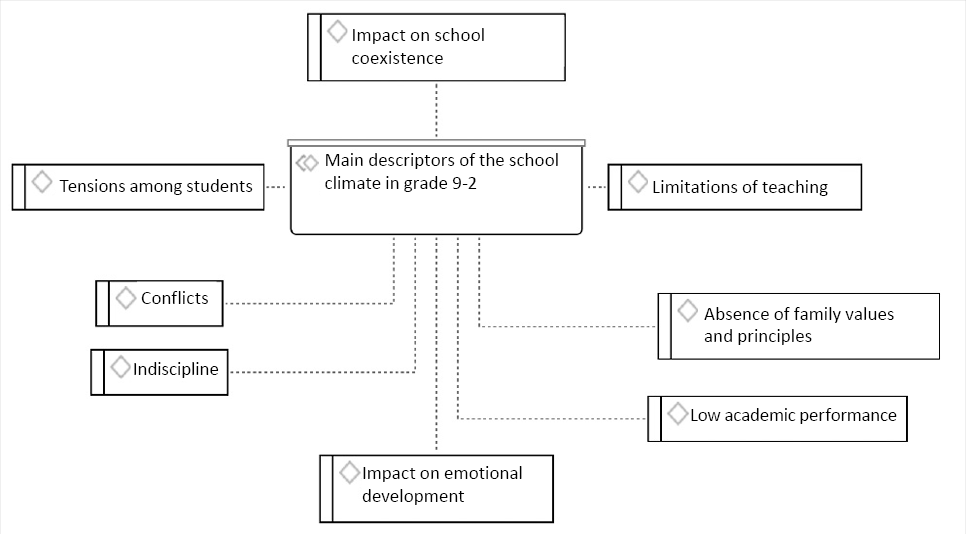
Fernández-Rojas (2021) argues that the presence of conflicts and undisciplined attitudes in the school context creates tensions between students and negatively affects the school climate. As Martínez (2020) says, this conflict-ridden environment directly affects coexistence by weakening interpersonal relationships and creating an environment that is not conducive to students’ emotional development. For Perlado et al. (2021), impaired emotional development can be linked to the absence of family values and principles. Aguirre et al. (2022) consider this to be a factor that limits teachers’ ability to manage these conflicts effectively.
In this regard, Arteaga´s (2020) research confirms that an environment of indiscipline and conflict in schools is directly associated with poor academic performance and negatively impacts the quality of learning. Together, these descriptors reflect the complex interplay of behavioral, emotional, and academic factors. This underscores the importance of addressing these challenges holistically to improve the school climate.
Basis for the selection of social skills
Regarding the findings related to the second specific objective of designing workshops based on social skills to strengthen the school climate for students, Corzo´s (2020) proposals were considered. Corzo argues that in educational environments with coexistence challenges, developing specific social skills is essential. These skills were selected based on their relevance to the issues observed, with the aim of promoting a more collaborative and respectful environment among students.
The workshop design was complemented by analyses derived from interviews with teachers at the institution, who pointed out recurring patterns of conflict and tension in student interactions. This made it possible to identify the most important social skills for overcoming difficulties in the school environment, such as empathy, assertive communication, conflict resolution, and critical thinking. Thus, the design adopted by the authors was based on the postulates of Pérez-Guevara and Puentes-Suárez (2022), who propose that, in contexts of toxic school climates, it is essential to work on skills such as empathy, interpersonal relationships, conflict resolution, assertive communication, and critical thinking, aspects that were considered in the design and development of the workshops (see Figure 2).
Figure 2
Frequent patterns in the ‘School climate’ category
Based on interviews with students, it was clear that they all recognized the need to improve the school climate and were positive about participating in the workshops. This finding was fundamental to the design of the activity, as the students’ willingness to collaborate was a key starting point for creating social skills-based workshops. Their openness not only facilitated the selection of specific skills such as empathy, assertive communication, and conflict resolution, but also reaffirmed the importance of applying these strategies to create a healthier, more supportive learning environment.
This fact is particularly relevant since Pérez-Guevara and Puentes-Suárez (2022) argue that the willingness of those involved is a key factor in effective conflict resolution. The authors argue that favorable conditions for addressing and solving problems constructively arise when participants recognize the need for change and show an open attitude.
Improvements observed after the implementation of social skills workshops
Figure 3
Student experience after the empathy workshop
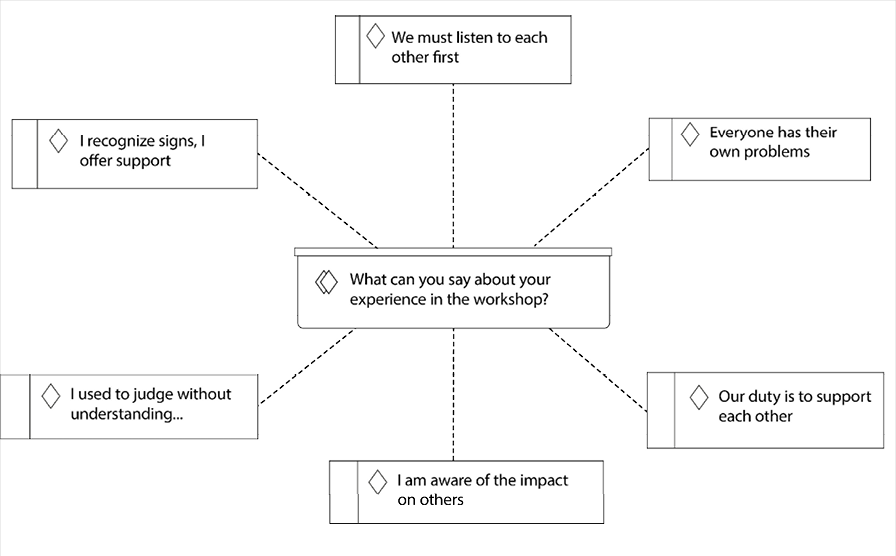
In response to the scope of the third specific objective and in light of the findings observed after the implementation of the social skills workshops, the empathy workshops generated a noticeable change in the students’ attitudes and behavior toward their peers. This change promoted an atmosphere of greater understanding and solidarity. This change aligns with the theoretical observations of Gómez and Muriel (2021), who assert that when empathy is internalized and practiced, it can become ingrained in students’ everyday behavior, creating conditions that are more conducive to coexistence and cooperation.
The positive impact of empathy was evident in the group’s social and emotional dynamics, consistent with Abellán-Roselló and DeLara-López (2021) findings, who emphasize that strengthening empathic skills promotes greater cohesion and reduces interpersonal conflicts, essential aspects for a healthy school climate. The students said the assertive communication workshop helped them express their thoughts and emotions respectfully, reducing tensions and conflicts in the classroom. This effect on communication was observed to improve interactions and promote open and constructive dialogue, which coincides with the findings of Riascos (2022), who pointed out that assertive communication reduces misunderstandings and promotes harmony in school life.
Additionally, workshops on problem and conflict management helped students develop the specific skills needed to effectively navigate difficult situations. Students acquired practical strategies for conflict resolution, which enabled them to address disagreements without confrontation and strengthen their interpersonal relationships.
In terms of critical thinking, students showed significant improvement in their ability to analyze and evaluate situations from different perspectives. This result indicated an improvement in their analytical skills and ability to make informed decisions, confirming Mindiola-Molina and Castro-Mendoza’s (2021) postulates on the importance of critical thinking in active participation and reflective approaches to situations. Students showed greater discernment in their interactions and decisions, which had a positive impact on the overall perception of the school climate and allowed them to face challenges more critically and constructively.
Similarly, students recognized the importance of communication and mutual respect. This strengthened group cohesion and significantly improved the quality of interpersonal relationships. These achievements demonstrate that implementing the workshops contributed to a more positive school climate and provided fundamental tools for comprehensive development in the educational sphere.
Evaluation of workshops based on social skills
To address the scope of the fourth specific objective, a comprehensive evaluation was conducted on the effectiveness of social skills development workshops, covering topics such as empathy, assertive communication, problem and conflict management, interpersonal relationships, and critical thinking. This evaluation revealed significant results, evidencing progress in student competencies, as well as the need to reflect on the teaching and learning processes to improve future implementation.
The evaluation of the first workshop, which focused on empathy, revealed that the students had significantly improved their ability to understand and share the experiences of their peers. Although this development strengthened their emotional connections and promoted an atmosphere of mutual support and understanding, some participants expressed difficulties in fully integrating this skill into their daily lives. This finding aligns with Herrero’s (2022) assertion that empathy is both an innate ability and a skill that requires constant training to be effective. Therefore, it is crucial to establish sustained practices that reinforce empathy as an essential component of student training.
As for the assertive communication workshop, students significantly improved their ability to express their opinions and feelings clearly and respectfully. This finding goes along with Arteaga´s (2020) statement that assertive communication is crucial for cultivating healthy relationships and peacefully resolving conflicts.
The evaluation of the interpersonal relations workshop revealed that participants were more open and willing to build meaningful connections. However, some students still resisted collaborative activities, highlighting the need for additional strategies to overcome these barriers. This finding is supported by the research of Pérez-Guevara and Puentes-Suárez (2022), who emphasize the fundamental role of positive interpersonal relationships in achieving academic and social success.
The problem-solving and conflict management workshop positively impacted students’ ability to handle situations and disagreements constructively. Many of them applied the strategies they learned during the workshop, suggesting that they acquired practical tools for managing tensions and resolving conflicts peacefully. However, others have difficulty applying these skills to everyday situations. This finding aligns with Corzo´s (2020) perspective that constructive conflict management requires practice and reinforcement in real-life situations.
The evaluation of the critical thinking workshop revealed a significant change in the students’ mindset, as they showed a more analytical and reflective approach to problem solving, which is a fundamental step in empowering them in their learning process and encouraging them to make informed decisions. This result is consistent with the ideas of Paul and Elder (2005), who believe that critical thinking is essential for skill development, as it allows students to analyze situations and make informed decisions.
Despite their achievements, not all students fully adopted the skills they worked on. In this regard, Gómez and Muriel (2021) emphasize the importance of consistently practicing social skills. In other words, it is essential to integrate these skills into the curriculum and daily activities of educational institutions.
The evaluation revealed substantial progress in developing skills such as empathy and conflict resolution. However, it is essential to continue promoting these competencies through constant practice and an environment that fosters their development. The evaluation of the workshops demonstrated not only progress in students’ social skills but also the need for a more comprehensive, sustained approach to implementing these initiatives.
Discussion
The results reflect a consensus among students who reported substantial improvements in key areas such as empathy, interpersonal relationships, conflict management, assertive communication, and critical thinking. These results support the idea that developing social skills significantly contributes to emotional well-being and positive adaptation (Perlado et al., 2021).
In response to the warning by Gómez and Muriel (2021), it is important to view these advances as a starting point. The continuous development of these skills requires sustained practice and recurring opportunities to apply them in various contexts.
Similarly, Corzo´s (2020) guidance was relevant, emphasizing the importance of specific social skills in educational settings like the one under study. These findings influenced the selection of essential social skills for addressing the identified challenges in ninth grade.
There were noticeable changes in students’ willingness to listen to and understand others’ perspectives, as well as to provide emotional support. According to Flórez-Madroñero and Prado-Chapid (2021), this change is reflected in everyday situations in which participants demonstrate a greater awareness of their peers’ emotions and needs. These authors emphasize the need to promote greater understanding and emotional connection among students by cultivating empathy through specific strategies. Perlado et al. (2021) argue that this practical approach provides concrete opportunities to develop and apply empathy in real-life situations.
Regarding the first objective, the results showed that the predominant climate corresponded to a toxic school environment. This finding aligns with the observations of Pérez-Guevara and Puentes-Suárez (2022), who explain that when conflicts are avoided or managed authoritatively, the environment tends to deteriorate, perpetuating a cycle of hostility that negatively impacts academic performance and the emotional and social well-being of students. Furthermore, this statement is supported by Liccardi’s (2021) analysis, which highlights that toxic school environments generate anxiety and demotivation, while also fostering dysfunctional coexistence dynamics and hindering an atmosphere conducive to learning and cooperation.
Regarding the second objective, the workshop design was based on Corzo´s (2020) theoretical approaches. Using participant observation and interview triangulation, the most relevant social skills for improving the school climate were identified from the prior diagnosis. Given that empathy enables students to connect emotionally with their peers and foster a supportive environment, it has been highlighted as a crucial skill, according to Ramírez and Tesén (2022). From Jaramillo´s perspective (2023), assertive communication is essential because it enables the clear and respectful expression of opinions, fostering a healthier exchange in the classroom. According to Herrera et al. (2022), conflict management is an action that fosters collaboration and understanding, thereby strengthening interpersonal relationships. Vargas et al. (2020) argue that problem-solving is also essential because an adequate perception of situations paves the way for conflict resolution. According to Gómez and Muriel (2021), critical thinking is a key competency that enables students to analyze and evaluate situations, thereby promoting informed decision-making.
Regarding the implementation of the workshops, it was observed that, although the students showed substantial improvement in their social skills, the observation by Gómez and Muriel (2021) that mastery of these skills requires constant practice should not be overlooked. Through the empathy workshop, students showed a significant increase in their ability to understand the emotions of others, which facilitated a more cohesive environment. The assertive communication workshop improved the way students expressed their needs and feelings, creating a more collaborative atmosphere. In conflict management, participants applied the strategies they learned to resolve disagreements constructively.
A positive impact on the effectiveness of the workshops was identified in the observed behaviors: students demonstrated greater empathy and improved communication skills. However, consolidating these skills requires sustained effort. As expected, the behaviors observed during the workshops showed that students demonstrated greater empathy and communication skills. It is essential to integrate these skills into their daily lives to ensure long-lasting benefits. In this regard, it is necessary to continue fostering an environment that supports the ongoing practice of social skills. As the literature suggests, the effectiveness and mastery of these skills are enhanced through repeated practice and steady effort reinforcement.
These results support the research question exploring the relationship between developing social skills and improving the school climate. It is essential to establish an approach that ensures students constantly practice these skills in their daily lives. This helps in creating a healthier school environment that fosters learning. Transforming the school environment requires more than just implementing workshops; it also requires an institutional commitment to cultivating a climate of respect and collaboration in the long term.
Conclusions
The conclusive analysis regarding school climate and social skills determines that identifying a toxic school climate indicates the need for more activities to transform the environment and promote a more conducive learning environment. Additionally, social skills such as empathy and assertive communication are essential for fostering a positive school environment. The results of the workshops suggest that consistently practicing these skills promotes individual student development and enhances group cohesion. Evaluations of the effectiveness of the workshops show that interventions aimed at strengthening social skills positively impact students’ behavior and interactions. This contributes to a more harmonious school climate. Taken together, these findings underscore the importance of continuing to develop social skills as a key strategy for enhancing well-being and fostering positive relationships in an educational setting.
Conflict of interest
The authors declare that no conflict of interest could compromise the reliability of this publication or affect the impartiality and integrity of the research and its results.
This statement is made in accordance with the journal’s ethical and editorial standards to ensure transparency and objectivity in the publication process.
Ethical considerations
The authors obtained informed consent from the guardians of the students participating in the study. The students’ rights were considered and respected, and no physical or psychological harm was caused. Additionally, the confidentiality and anonymity of the data were maintained.
Sources of funding
The resources provided in this research were supplied by the associate researchers (authors of the article), with the support of Universidad Mariana.
References
Abellán-Roselló, L., & DeLara-López, Á. (2021). Autocontrol emocional y adquisición de habilidades sociales en estudiantes a través de terapias con animales [Emotional self-control and social skills acquisition in students through animal therapy]. Educación y Sociedad, 19(1), 77-92. https://revistas.unica.cu/index.php/edusoc/article/view/1685
Aguirre, G. N., Caffo, M. E., Galarza, K. V., Dueñas, H. F., & Rojas, W. J. (2022). Habilidades sociales y el clima escolar en una institución educativa pública de Lima [Social skills and school climate in a public educational institution in Lima]. Horizontes Revista de Investigación en Ciencias de la Educación, 6(26), 1941-1950. https://doi.org/10.33996/revistahorizontes.v6i26.463
Arón, A. M., & Milicic, N. (2000). Climas sociales tóxicos y climas nutritivos para el desarrollo personal en el contexto escolar [Toxic and nutritive social school climates and personal development in school contexts]. Revista Psykhé, 9(2), 117-124. https://ojs.uc.cl/index.php/psykhe/article/view/20495/16957
Arteaga, A. Y. (2020). Clima escolar en el aula, en estudiantes del 6.° grado de una institución educativa pública del Callao [School climate in the classroom, among sixth-grade students at a public educational institution in Callao] [Tesis de maestría, Universidad San Ignacio de Loyola]. Repositorio USIL. https://hdl.handle.net/20.500.14005/10399
Ascorra, P., Arias, H., & Graff, C. (2003). La escuela como contexto de contención social y afectiva [School as a context of social and affective contention]. Revista Enfoques Educacionales, 5(1), 117-123. https://enfoqueseducacionales.uchile.cl/index.php/REE/article/view/47518
Babarro, N. (2021). Habilidades sociales: qué son, tipos, listado y ejemplos [Social skills: what they are, types, list, and examples]. https://www.psicologia-online.com/habilidades-sociales-que-son-tipos-listado-y-ejemplos-4587.html
Calderón-González, N. G., & Vera-Noriega, J. Á. (2022). La valoración de estudiantes acerca del clima escolar, convivencia y violencia en escuelas secundarias del noroeste de México [Students’ assessment of school climate, coexistence, and violence in secondary schools in northwestern Mexico]. Educare, 26(3), 186-201. http://dx.doi.org/10.15359/ree.26-3.11
Campos, M. A. (2020). Clima escolar y libertad de expresión en adolescentes [School climate and freedom of expression in adolescents]. Ajayu Órgano de Difusión Científica del Departamento de Psicología, 18(1), 214-243. http://www.scielo.org.bo/pdf/rap/v18n1/v18n1_a09.pdf
Colmenares, A. M., & Piñero, M. L. (2008). La investigación-acción. Una herramienta metodológica heurística para la comprensión y transformación de realidades y prácticas socioeducativas [Action research. A heuristic methodological tool for understanding and transforming socio-educational realities and practices]. Laurus, 14(27), 96-114. https://www.redalyc.org/pdf/761/76111892006.pdf
Corzo, Y. A. (2020). Fortalecimiento de las habilidades sociales en los niños de transición a través de una propuesta pedagógica en una institución pública de la ciudad de Bucaramanga [Strengthening social skills in transition children through an educational proposal in a public institution in the city of Bucaramanga] [Tesis de maestría, Universidad Autónoma de Bucaramanga]. Repositorio Institucional UNAB http://hdl.handle.net/20.500.12749/12087
Esteves, A. R., Paredes, R. P., Calcina, C. R., & Yapuchura, C. R. (2020). Habilidades sociales en adolescentes y funcionalidad familiar [Social Skills in adolescents and family functionality]. Comuni@cción: Revista de Investigación en Comunicación y Desarrollo, 11(1), 16-27. https://doi.org/10.33595/2226-1478.11.1.392
Fernández-Rojas, M. A. (2021). Estilos de comunicación para abordar los conflictos en el aula de clase [Communication styles to address conflicts in the classroom]. Revista Criterios, 28(2), 28-47. https://doi.org/10.31948/rev.criterios/28.2-art2
Flórez-Madroñero, A. C., & Prado-Chapid, M. F. (2021). Habilidades sociales para la vida: empatía, relaciones interpersonales y comunicación asertiva en adolescentes escolarizados [Social skills for life: empathy, interpersonal relationships, and assertive communication in school-aged adolescents]. InvestigiumIRE, 12(2), 13-26. https://doi.org/10.15658/INVESTIGIUMIRE.221202.02
Gómez, V. E. (2019). El clima escolar desde la perspectiva de los estudiantes y docentes de los grados 11.º de la I.E. Santa Gema, Buriticá, Antioquía, Colombia [The school climate from the perspective of students and teachers in 11th grade at I.E. Santa Gema, Buriticá, Antioquia, Colombia] [Tesis de maestría, Universidad de Medellín]. Repositorio Institucional Universidad de Medellín. http://hdl.handle.net/11407/6257
Gómez, A. I., & Muriel, D. F. (2021). Empatía y asertividad como habilidades sociales para fortalecer la convivencia escolar [Empathy and assertiveness as social skills to strengthen school coexistence] [Tesis de maestría, Universidad Católica de Manizales]. Repositorio Digital UCM. https://repositorio.ucm.edu.co/handle/10839/3494
Guevara, G. P., Verdesoto, A. E., & Castro, N. E. (2020). Metodologías de investigación educativa (descriptivas, experimentales, participativas y de investigación-acción) [Educational research methodologies (descriptive, experimental, participatory, and action research)]. RECIMUNDO, 4(3), 163-173. https://doi.org/10.26820/recimundo/4.(3).julio.2020.163-173
Hernández, R., Fernández, C., & Baptista, P. (2014). Metodología de la investigación [Research Methodology] (6.th ed.). McGraw-Hill Interamericana.
Herrero, A. (2022). Habilidades sociales. Aprendizaje de la asertividad y autogestión emocional [Social skills. Learning assertiveness and emotional self-management] [Tesis de pregrado, Universidad de Valladolid]. UVadoc. https://uvadoc.uva.es/handle/10324/54249
Jaramillo, D. M. (2023). Comunicación asertiva y clima escolar en estudiantes del VI ciclo de una institución educativa pública de Nuevo Progreso 2023 [Assertive communication and school climate in sixth-cycle students at a public educational institution in Nuevo Progreso, 2023] [Tesis de maestría, Universidad César Vallejo]. Repositorio Digital Institucional UCV. https://hdl.handle.net/20.500.12692/124544
Liccardi, G. (2021). Intimidación, ciberbullying y gestión de emociones en escolares sicilianos de educación primaria [Bullying, cyberbullying, and emotion management among Sicilian primary school students] [Tesis doctoral, Universidad de Murcia]. Portal de investigación Universidad de Murcia. https://dialnet.unirioja.es/servlet/tesis?codigo=305458
López, E. (2021). El clima escolar para la convivencia: un constructo teórico desde la perspectiva de los actores educativos [The school climate for coexistence: a theoretical construct from the perspective of educational actors] [Tesis doctoral inédita]. Universidad Experimental Pedagógica Libertador.
Martínez, D. M. (2020). La mediación como estrategia de resolución de conflictos pacífica en el ámbito escolar [Mediation as a pacific conflict resolution strategy in the school scope]. Revista Educare, 24(1), 222-244. https://doi.org/10.46498/reduipb.v24i1.1276
Martínez-González, J. S. (2021). Metodología de la investigación de un proyecto [Project research methodology]. Con-Ciencia Serrana Boletín Científico de la Escuela Preparatoria Ixtlahuaco, 3(5), 25-27. https://repository.uaeh.edu.mx/revistas/index.php/ixtlahuaco/article/view/6861
Mindiola-Molina, I. Y., & Castro-Mendoza, J. C. (2021). Desarrollo del pensamiento crítico a través de foros de discusión asincrónicos con estudiantes de 8° grado [Developing critical thinking through asynchronous discussion forums with 8th grade students]. Revista UNIMAR, 39(1), 126–144. https://doi.org/10.31948/Rev.unimar/unimar39-1-art9
Monjas, M. I. (2021). El complejo mundo de las relaciones interpersonales [The complex world of interpersonal relationships]. Pirámide.
Niño, V. M. (2019). Metodología de la investigación. Diseño, ejecución e informe [Research methodology. Design, implementation, and report] (2.nd ed.). Ediciones de la U.
Organización de las Naciones Unidas para la Educación, la Ciencia y la Cultura (UNESCO). (2013). Análisis del clima escolar, ¿poderoso factor que explica el aprendizaje en América Latina y el Caribe? [School climate analysis: a powerful factor explaining learning in Latin America and the Caribbean?]. UNESCO.
Paul, R., & Elder, L. (2005). Una guía para los educadores en los estándares de competencia para el pensamiento crítico. Estándares, principios, desempeño, indicadores y resultados con una rúbrica maestra en el pensamiento crítico [A guide for educators on competency standards for critical thinking. Standards, principles, performance, indicators, and outcomes with a master rubric for critical thinking]. https://www.criticalthinking.org/resources/PDF/SP-Comp_Standards.pdf
Pérez, J., Alcalá, M., Carrillo, M., & Arellano, W. (2022). Clima escolar familiar y su relación con el rendimiento académico: Aplicación en instituciones educativas rurales [Family school climate and its relationship with academic performance: Application in rural educational institutions]. Revista de Ciencias Sociales, XXVIII(especial 6), 110-125. https://www.redalyc.org/journal/280/28073815008/
Pérez-Guevara, D. J., & Puentes-Suárez, A. I. (2022). Clima escolar: conceptualización y variables [School climate: conceptualization and variables]. Pensamiento y Acción, (32), 51-71. https://doi.org/10.19053/01201190.n32.2022.13933
Perlado, I., Torrego, J. C., & Muñoz, Y. (2021). Habilidades sociales y aprendizaje cooperativo en la inclusión de estudiantes con necesidades educativas específicas [Social skills and cooperative learning in the inclusion of students with specific educational needs]. Revista Brasileira de Educação Especial, 27, 953-970. https://doi.org/10.1590/1980-54702021v27e0066
Piñero, M. L., & Rivera, M. E. (2015). Aprender-hacer investigación en la formación docente desde la mirada de los estudiantes de la Upel IPB [Learning to conduct research in teacher training from the perspective of students at Upel IPB]. Arje, Revista de Postgrado FACE-UC, 9(16), 177-217. http://servicio.bc.uc.edu.ve/educacion/arje/arj16/art10.pdf
Ramírez, J. N., & Tesén, J. (2022). Las relaciones interpersonales y la calidad educativa [Interpersonal relationships and educational quality]. TecnoHumanismo, 2(3), 17-34. https://dialnet.unirioja.es/servlet/articulo?codigo=8356012
Riascos, A. S. (2022). Diseño de una estrategia lúdico-pedagógica para fomentar la comunicación asertiva en los estudiantes del grado cuarto de la I.E. Dos Quebradas, López de Micay-Cauca [Design of a playful-pedagogical strategy to promote assertive communication among fourth-grade students at I.E. Dos Quebradas, López de Micay-Cauca] [Trabajo de especialización, Fundación Universitaria Los Libertadores]. Academicus Repositorio. http://hdl.handle.net/11371/5514
Rivera, A. G. (2022, 12 de enero). Clima escolar: el cimiento de la educación de calidad [School climate: the foundation of quality education] [Blog]. Luca. https://lucaedu.com/clima-escolar/
Roca, E. (2014). Cómo mejorar tus habilidades sociales. Programa de asertividad, autoestima e inteligencia emocional [How to improve your social skills. Assertiveness, self-esteem, and emotional intelligence program] (4.th ed.). ACDE Ediciones.
Ruiz, G. M. (2022). El clima escolar como eje fundamental para el mejoramiento de la calidad educativa [The school climate as a fundamental axis for improving educational quality]. Revista Dialogus, (8), 12-23. https://doi.org/10.37594/dialogus.v1i8.524
Sánchez, M., Fernández, M., & Díaz, J. (2021). Técnicas e instrumentos de recolección de información: análisis y procesamiento realizados por el investigador cualitativo [Techniques and tools for gathering information: analysis and processing carried out by the qualitative researcher]. Revista Científica UISRAEL, 8(1), 107-121. https://doi.org/10.35290/rcui.v8n1.2021.400
Vargas, K., Yana, M., Pérez, K., Chura, W., & Alanoca, R. (2020). Aprendizaje colaborativo: una estrategia que humaniza la educación [Collaborative learning: a strategy that humanizes education]. Revista Innova Educación, 2(2), 363-379. https://doi.org/10.35622/j.rie.2020.02.009
Contribution
Jimmy Spencer Ramírez Martínez and José Julio Pereira Mendoza: Literature review and development, methodological design, category coding, category analysis, interview triangulation, initial manuscript drafting, and final manuscript review.
Luz Karine Jiménez Ruiz: Supervision and management of the study, advice on the analysis and writing of the manuscript, as well as methodological and stylistic guidance.
The authors participated in the preparation, reading, and approval of the article.
Master’s student in Education. Professor, Institución Educativa Técnica Roig y Villalba. E-mail: jimmyramirez3@gmail.com

2 Master’s student in Education. Sociologist, Universidad Popular del Cesar. E-mail: josepereiramendoza@gmail.com
3 Doctorate in Innovation Management. Associate researcher at Minciencias. Professor at the Universidad Popular del Cesar. luzjimenez@unicesar.edu.co.